
Commonwealth Portal is grateful to the following individual and business supporter, who has enabled us to maintain and expand the contents regarding Malaysia.
The name “Malaysia” is derived from the word “Malay,” which historically referred to the ethnic group and language predominantly spoken in the region, combined with the Latin suffix “-ia,” denoting a land or country. The term “Malaya” was used in the colonial period to refer to the Malay Peninsula and, later, to the Federation of Malaya, which formed the core of modern-day Malaysia. The country officially adopted the name “Malaysia” upon its formation in 1963 to reflect the inclusion of the states of Sabah, Sarawak, and Singapore (the latter of which later became an independent city-state in 1965).
People from Malaysia are known as Malaysians, and the dominant ethnic group in the country are the Malays, though other significant ethnic communities include the Chinese, Indians, and various indigenous groups, collectively contributing to the multicultural identity of the nation.
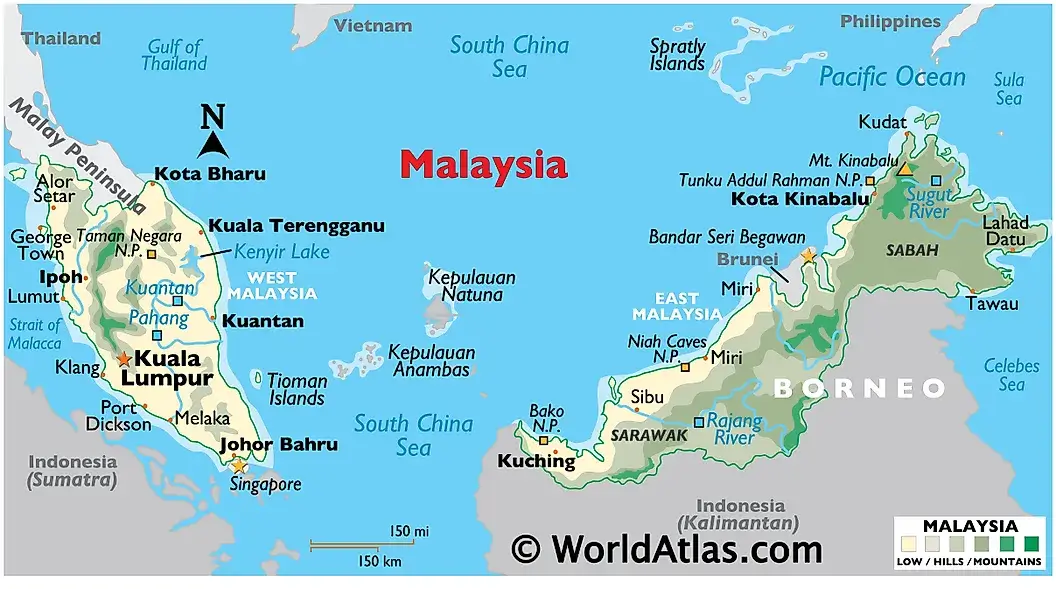
Malaysia is geographically divided into two main regions: Peninsular Malaysia (also known as West Malaysia) and East Malaysia, which includes the states of Sabah and Sarawak on the island of Borneo. Peninsular Malaysia is bordered by Thailand to the north, while East Malaysia shares borders with Brunei and Indonesia. The country has a diverse landscape, ranging from coastal plains to mountainous regions. The Titiwangsa Mountains in the centre of Peninsular Malaysia and the Crocker Range in Borneo are the two primary mountain ranges.
The country is also home to lush rainforests, extensive river systems, and over 4,000 kilometres of coastline. Malaysia has a tropical climate, characterised by high humidity and significant rainfall, with distinct wet and dry seasons. The climate and diverse ecosystems make Malaysia a biodiversity hotspot, home to unique flora and fauna, including the Malayan tiger, orangutans, and various species of tropical birds.
Malaysia operates as a federal parliamentary democracy with a constitutional monarchy. The King (Yang di-Pertuan Agong) is the ceremonial head of state, while the Prime Minister is the head of government and exercises executive power. The monarchy rotates every five years among the nine hereditary rulers of the Malay states, and the selection of the king is a unique feature of Malaysia’s political system.
The Parliament of Malaysia consists of two houses: the Dewan Rakyat (House of Representatives) and the Dewan Negara (Senate). The country’s political parties are diverse, with the United Malays National Organisation (UMNO), the Democratic Action Party (DAP), and the People’s Justice Party (PKR) being among the most influential. Malaysian politics have been shaped by coalitions, and in recent years, the country has seen significant political changes, including the 2018 elections that saw the Pakatan Harapan coalition, led by former Prime Minister Mahathir Mohamad, defeating the long-dominant Barisan Nasional coalition.
The country has faced various political challenges, including corruption, political instability, and debates over the balance between Islam and secularism. The political system, however, remains largely stable, with regular elections and peaceful transitions of power, despite some tensions within the multi-ethnic society.
Malaysia’s economy is one of the most developed in Southeast Asia, driven by a combination of industrialisation, natural resources, and a growing services sector. The country’s economy has undergone significant transformation since gaining independence, moving from being largely reliant on agriculture to becoming a manufacturing and export-oriented economy.
Malaysia is a major exporter of natural resources, particularly petroleum, palm oil, rubber, and timber. The country is the world’s second-largest producer of palm oil, which is a key agricultural export. Additionally, Malaysia has a thriving electronics industry, with the manufacturing of semiconductors, electrical appliances, and computer hardware contributing significantly to its economy.
The services sector, particularly finance, banking, tourism, and technology, has become an increasingly important part of the economy. The country’s strategic location along major global shipping routes also makes it an important trade hub.
Despite impressive economic growth, Malaysia faces challenges such as income inequality, rising household debt, and a reliance on exports of raw materials. The government has introduced various initiatives to diversify the economy, promote innovation, and address issues such as corruption, with the aim of positioning Malaysia as a high-income nation.
Malaysia has a population of approximately 33 million, with a predominantly young and urbanising population. The country is home to a diverse range of ethnic groups, with the Malays, Chinese, and Indians being the three largest communities. The Malays are the dominant ethnic group and follow Islam, while the Chinese community is largely Buddhist or Christian, and the Indian community is mainly Hindu. There are also numerous indigenous groups, including the Orang Asli in Peninsular Malaysia and the Dayak in Borneo.
The population is split between urban and rural areas, with around 75% of the population living in urban centres. Kuala Lumpur, Penang, Johor Bahru, and Ipoh are some of the major urban areas, contributing significantly to Malaysia’s economy and cultural life. The country has a relatively high literacy rate, and education is a key focus of national policy, with a dual-language education system in Malay and English.
Malaysia has a growing middle class, and its demographic trends show an increasing number of young people seeking higher education and employment opportunities. However, the country faces challenges related to ageing demographics, ethnic diversity, and the integration of rural populations into urban economies.
Malaysia’s culture is a vibrant fusion of various traditions, influenced by its diverse ethnic makeup, historical connections, and religious practices. The country celebrates a rich array of festivals, such as Hari Raya Aidilfitri (celebrating the end of Ramadan), Chinese New Year, Deepavali, and Christmas, reflecting the multicultural fabric of Malaysian society.
Traditional arts and crafts, such as batik, wood carving, and songket weaving, are important expressions of Malaysia’s cultural heritage. The performing arts also play a central role, with traditional dances such as the Malay Zapin, Chinese lion dances, and Indian Bharatanatyam contributing to the country’s cultural diversity.
Malaysian cuisine is famous for its variety, combining Malay, Chinese, Indian, and indigenous flavours. Dishes like nasi lemak (coconut rice), satay (grilled meat skewers), and roti canai (Indian flatbread) are popular across the country.
Malaysia has historical ties with the Commonwealth of Nations, stemming from its period under British colonial rule as the Federation of Malaya. Following independence in 1957, Malaysia became a member of the Commonwealth and has since maintained strong relations with other member states.
The country has contributed to various Commonwealth initiatives, particularly in the fields of education, governance, and sustainable development. Malaysia’s involvement in the Commonwealth also reflects its commitment to democracy, human rights, and economic cooperation with other nations. The country continues to participate actively in Commonwealth events and collaborations, reinforcing its position as an important player within the global community.
