
Commonwealth Portal is grateful to the following individual and business supporter, who has enabled us to maintain and expand the contents regarding Kiribati.
The name “Kiribati” is derived from the Gilbert Islands, named after the British explorer Thomas Gilbert, who first visited the islands in 1788. The pronunciation of “Gilbert” in the local language of Gilbertese (I-Kiribati) led to the modern form “Kiribati.” The country’s official language is Gilbertese (I-Kiribati), although English is also used in government, education, and business.
In terms of terminology, citizens of Kiribati are known as I-Kiribati. The country is a republic, and its people have a unique cultural identity deeply rooted in the Pacific region, with strong connections to the ocean and traditional island lifestyles.
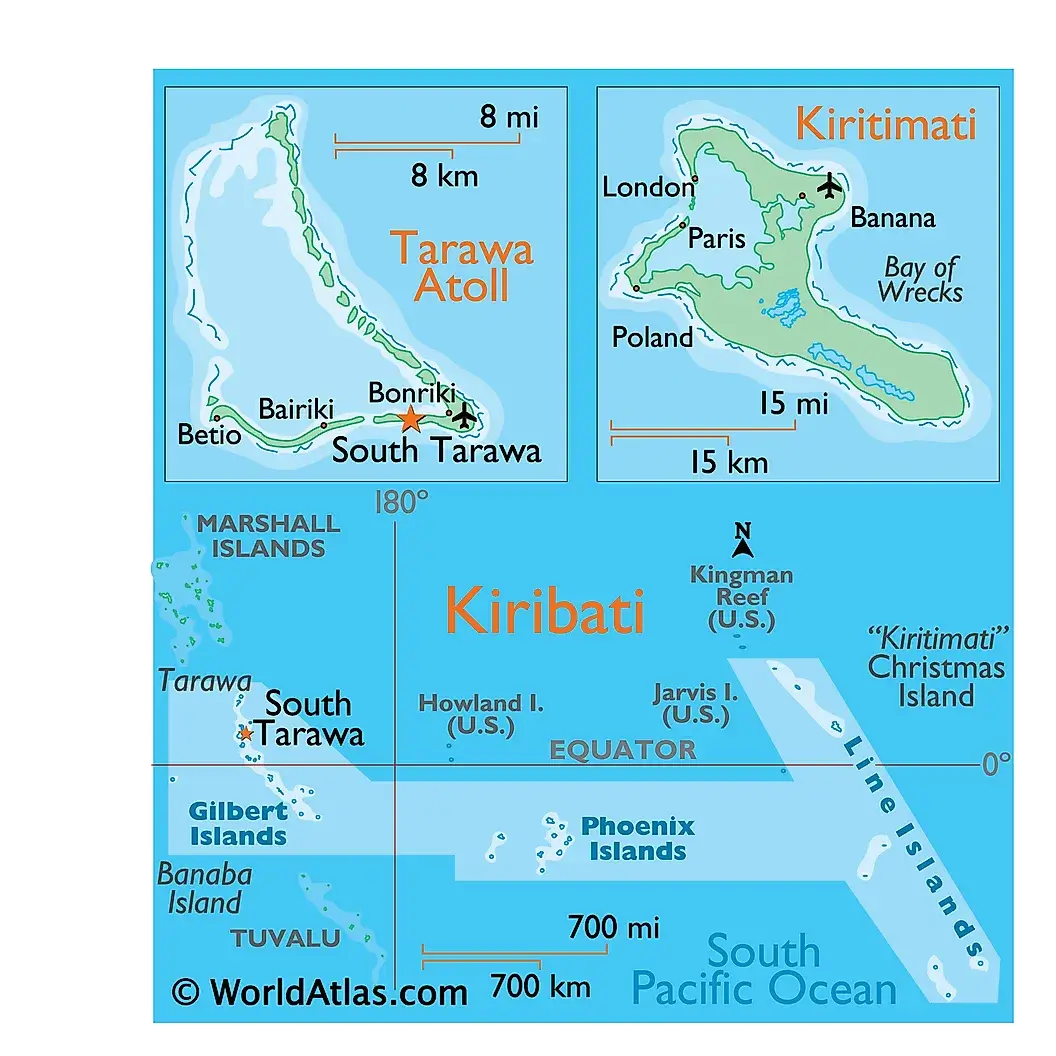
Kiribati is made up of 33 coral atolls and islands spread across a vast expanse of ocean, covering over 3.5 million square kilometres. The islands are scattered across the equator and straddle both the northern and southern hemispheres. These islands are divided into three main groups: the Gilbert Islands, the Phoenix Islands, and the Line Islands.
The majority of the country’s population lives on the Gilbert Islands, particularly the atoll of Tarawa, which is home to the capital and the most developed infrastructure in the country. Other inhabited atolls include Abemama, Butaritari, and Kiritimati, the largest atoll in the world, which is part of the Line Islands group.
Kiribati’s geography presents numerous challenges, particularly related to its low-lying nature. Most of the islands are just a few metres above sea level, making the country extremely vulnerable to rising sea levels caused by climate change. In fact, Kiribati is often considered one of the countries most at risk from the impacts of global warming, including flooding, coastal erosion, and changes to fishing stocks.
Kiribati is a republic with a presidential system of government. The President, who is both the head of state and the head of government, is elected every four years by popular vote. The country has a unicameral legislature, the Maneaba ni Maungatabu (House of Assembly), consisting of 46 members, who are also elected by the people.
The political system in Kiribati is multi-party, though political parties are relatively small and often focused on local issues rather than national ones. The country has experienced relative political stability since independence, although challenges such as internal migration, economic development, and the impact of climate change on the islands are major concerns.
The country’s political environment is heavily influenced by its geographic isolation and vulnerability to global issues such as climate change and international economic trends. Kiribati has been an advocate for climate change awareness, particularly as the rising sea levels threaten its very existence.
Fiji is a member of various international organisations, including the United Nations, the Pacific Islands Forum, and the Commonwealth of Nations. It has been an advocate for environmental issues, particularly in the context of climate change, and has actively participated in global efforts to combat environmental degradation.
Kiribati’s economy is small and heavily reliant on the natural resources of its islands, such as fishing, agriculture, and tourism. The country’s vast ocean territory is rich in marine life, and tuna fishing is one of the country’s most important industries, providing both domestic sustenance and export revenue. Kiribati has signed numerous fishing agreements with other countries to make the most of its Exclusive Economic Zone (EEZ), which covers a vast portion of the Pacific Ocean.
Agriculture in Kiribati is limited due to the poor soil quality on most of the islands. Copra (dried coconut meat), coconuts, and pandanus are the main agricultural products, with limited cultivation of root crops such as taro and yams. In recent years, there have been efforts to improve food security by introducing new agricultural techniques and diversifying production.
Tourism is another potential source of income, although it remains underdeveloped. The country’s pristine natural environment, coral reefs, and marine biodiversity are attractive to ecotourists, but infrastructure remains a significant barrier to the growth of this sector.
Due to the country’s limited natural resources and reliance on external aid and remittances, Kiribati remains one of the poorest countries in the Pacific region. Economic growth is hindered by geographical isolation, high transportation costs, and vulnerability to climate change. The country has increasingly turned to international aid and partnerships, including with Australia and New Zealand, to sustain its economy and develop its infrastructure.
Kiribati has a population of approximately 120,000 people, with the majority living on the Gilbert Islands, particularly on Tarawa. The population is predominantly of Micronesian descent, and the official languages are Gilbertese (I-Kiribati) and English, with Gilbertese being spoken by the vast majority of the population.
The population has a relatively high birth rate, but the country is facing significant challenges related to healthcare, including high infant mortality rates and limited access to medical services. Education is free and compulsory for children aged 6 to 14, though there are challenges in providing adequate facilities and resources for the growing population.
A significant issue in Kiribati is internal migration, as many people are moving from the outer islands to the capital, Tarawa, in search of better employment and living conditions. This rural-to-urban migration has led to overcrowding and strain on the limited infrastructure in Tarawa.
One of the most pressing demographic concerns is the potential displacement of the entire population due to rising sea levels. The government has been exploring options for relocating the population to other countries, such as Fiji or New Zealand, as part of its climate change adaptation strategies.
The culture of Kiribati is deeply tied to the sea, with fishing and navigation being central to the islanders’ way of life. Traditional navigation techniques, including the use of stars and ocean swells, are still passed down from generation to generation. The I-Kiribati people have a strong sense of community, and their social structure is based on family and extended family ties.
Kiribati’s traditional arts include weaving, mat-making, and carving, with the people using natural materials such as coconut leaves and pandanus. Music and dance also play an important role in Kiribati culture, with traditional songs and dances performed at ceremonies and celebrations.
Christianity, brought by missionaries in the 19th century, is the dominant religion in Kiribati, with the majority of the population identifying as Roman Catholic or Protestant. Religious observances and festivals, such as Christmas and Easter, are central to the national calendar.
Kiribati is a member of the Commonwealth of Nations, an organisation of 56 countries, most of which are former British colonies. Although Kiribati was never directly a part of the British Empire, it was a British protectorate and a colony before independence. The country’s ties to the Commonwealth provide opportunities for diplomatic and trade relations, and it actively participates in the Commonwealth’s efforts to address global challenges, particularly climate change.
Kiribati is a vocal advocate for climate action, often raising its concerns about rising sea levels at international forums such as the United Nations and the Commonwealth. The country’s participation in the Commonwealth has allowed it to strengthen its voice on environmental issues, advocating for global commitments to reduce carbon emissions and address the impacts of climate change.
