
Commonwealth Portal is grateful to the following individual and business supporter, who has enabled us to maintain and expand the contents regarding Kenya.
The name “Kenya” is derived from Mount Kenya, the highest peak in the country, which in turn originates from the Kikuyu, Embu, and Kamba names for the mountain, which are “Kirinyaga” or “Kerenyaga”, meaning “the mountain of whiteness” (in reference to the snowcap). When the British arrived in the late 19th century, the name was Anglicised to Kenya, and the mountain came to represent the nation as a whole.
Kenya’s inhabitants are known as Kenyans, and the country’s official languages are English and Swahili. Swahili, a Bantu language, serves as a lingua franca and unifying language, while English is used in government, education, and business. The term “Kenya” is widely used internationally to refer not only to the country but also to the distinct cultural, economic, and political identity that it embodies.
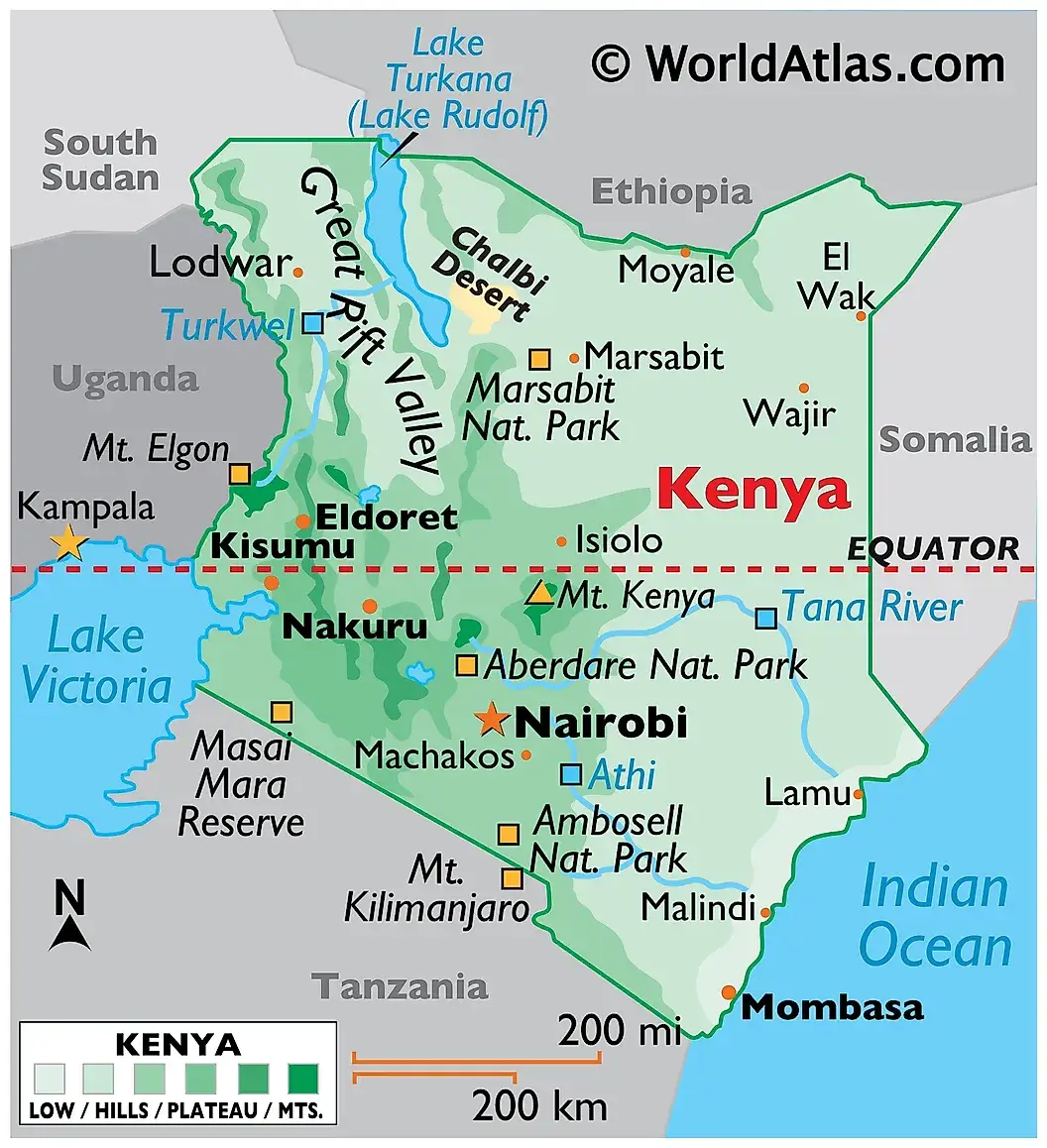
Kenya is strategically located on the eastern coast of Africa, bordered by Ethiopia to the north, Somalia to the east, Tanzania to the south, Uganda to the west, and South Sudan to the northwest. It also has a coastline along the Indian Ocean to the southeast.
The country’s geography is diverse, ranging from the low-lying coastal plains in the southeast to the fertile highlands in the west and the Great Rift Valley that runs through the country from north to south. The Great Rift Valley, which is home to various volcanic mountains and lakes, including Lake Nakuru and Lake Naivasha, is a UNESCO World Heritage site.
Kenya’s climate varies depending on the region, from the arid conditions of the northern and eastern parts of the country to the more temperate climate in the central highlands. The fertile central highlands are the country’s agricultural heartland, while the semi-arid regions in the north face significant challenges related to drought and food security.
Kenya operates as a presidential republic, where the President is both the head of state and the head of government. The political system is based on a multi-party framework, and the President is elected for a five-year term. The country’s legislative branch consists of a bicameral Parliament, which includes the National Assembly and the Senate.
Kenya gained independence from Britain in 1963, and since then, the country has undergone various political reforms. From the 1960s through the 1980s, Kenya was under the rule of a single party, the Kenya African National Union (KANU), led by Jomo Kenyatta and later Daniel arap Moi. In 1991, Kenya adopted a multi-party system, leading to greater political competition and the eventual emergence of the National Rainbow Coalition (NARC), which won the 2002 elections and ended KANU’s dominance.
Kenya’s political landscape is often influenced by ethnic considerations, with various ethnic groups vying for political power. Ethnic tensions have historically been a source of conflict, particularly during election periods. The 2007–2008 post-election violence, which was driven by disputes over election results, led to the deaths of over a thousand people and left many more displaced. Since then, Kenya has made significant efforts to build national unity and reform its political structures.
Kenya has one of the largest economies in Sub-Saharan Africa, with a GDP of approximately $95 billion as of 2023. The economy is diverse, with agriculture, services, and industry playing key roles in its development.
Agriculture is the backbone of Kenya’s economy, employing over 75% of the population. The main agricultural exports include tea, coffee, flowers, and horticultural products. Kenya is one of the world’s leading exporters of tea and cut flowers, particularly roses. Livestock farming is also significant, particularly in the arid and semi-arid regions.
The services sector, including tourism, is another key contributor to Kenya’s economy. The country’s national parks, wildlife, and coastal attractions draw millions of tourists each year, making tourism one of the primary foreign exchange earners. Nairobi is also a regional hub for banking and finance, with a growing technology sector, often referred to as “Silicon Savannah”, that has attracted international attention.
Kenya’s industrial sector is diverse, with manufacturing, construction, and energy being key contributors. The country has invested in infrastructure development, including roads, airports, and energy production, although challenges such as unemployment, poverty, and inequality persist.
Kenya is a multi-ethnic society, with over 40 distinct ethnic groups. The largest ethnic group is the Kikuyu, followed by the Luhya, Luo, Kalenjin, Maasai, and others. Swahili, as a lingua franca, is widely spoken, and English is the official language of government and business.
The population of Kenya is young, with a median age of about 20 years, which poses both opportunities and challenges. While the youth provide a vibrant workforce, they also face high levels of unemployment and limited access to quality education and healthcare.
Kenya’s life expectancy has increased over the years, and the country has made significant strides in healthcare, although challenges such as maternal mortality and the prevalence of diseases like malaria and HIV/AIDS remain.
Kenyan culture is rich and diverse, shaped by the many ethnic groups that make up the population. Each group has its own distinct language, traditions, and customs, though Swahili serves as a unifying language. Music, dance, and art play a central role in Kenyan life, with traditional music and dance performances still widely enjoyed.
Kenya is globally renowned for its athletes, particularly in long-distance running. Kenyan runners have dominated international competitions, and the country has produced some of the world’s greatest athletes, such as Eliud Kipchoge and Vivian Cheruiyot.
The nation is also known for its literary contributions, with writers like Ngũgĩ wa Thiong’o and Binyavanga Wainaina achieving international acclaim for their works that reflect Kenyan society and its challenges.
Kenyan cuisine is diverse, with popular dishes such as ugali (a maize-based dish), nyama choma (grilled meat), and sukuma (collard greens). The food reflects the agricultural practices of the country and is often enjoyed in communal settings.
Kenya is a member of the Commonwealth of Nations, an organisation of 56 member countries, most of which are former territories of the British Empire. Although Kenya gained independence from Britain in 1963, it maintains strong ties with the Commonwealth. The relationship provides opportunities for diplomatic, cultural, and trade exchanges, and Kenya participates in events such as the Commonwealth Games.
Kenya’s relationship with the Commonwealth is generally positive, and it has used the platform to advocate for regional cooperation, development, and peace. As one of the most politically and economically influential nations in East Africa, Kenya plays a prominent role within the Commonwealth, contributing to discussions on key global issues, particularly those affecting developing nations.
