
The name “India” is derived from the River Indus, which was historically significant to the ancient civilisation of the Indian subcontinent. The term “India” came to the Western world through ancient Greek and Latin languages, influenced by the Sanskrit word “Sindhu,” which was the name for the Indus River. As the river formed a major geographical boundary of the early Indian civilisations, the term evolved to describe the entire subcontinent.
The term “Bharat,” derived from the ancient Sanskrit name of the land, is also used to refer to the country. “Bharat” has roots in Indian mythological traditions, with the name signifying a legendary king of the Mahabharata, King Bharata, from whom the country is said to have derived its name. The official Hindi name for the country is “Bharat,” which is also widely used domestically, particularly in government and legal contexts.
People from India are referred to as “Indians,” and the country’s diverse culture is often reflected in the use of various terms such as “South Asians” in broader geographical contexts, though such distinctions can often overlook the intricate diversity within the subcontinent itself.
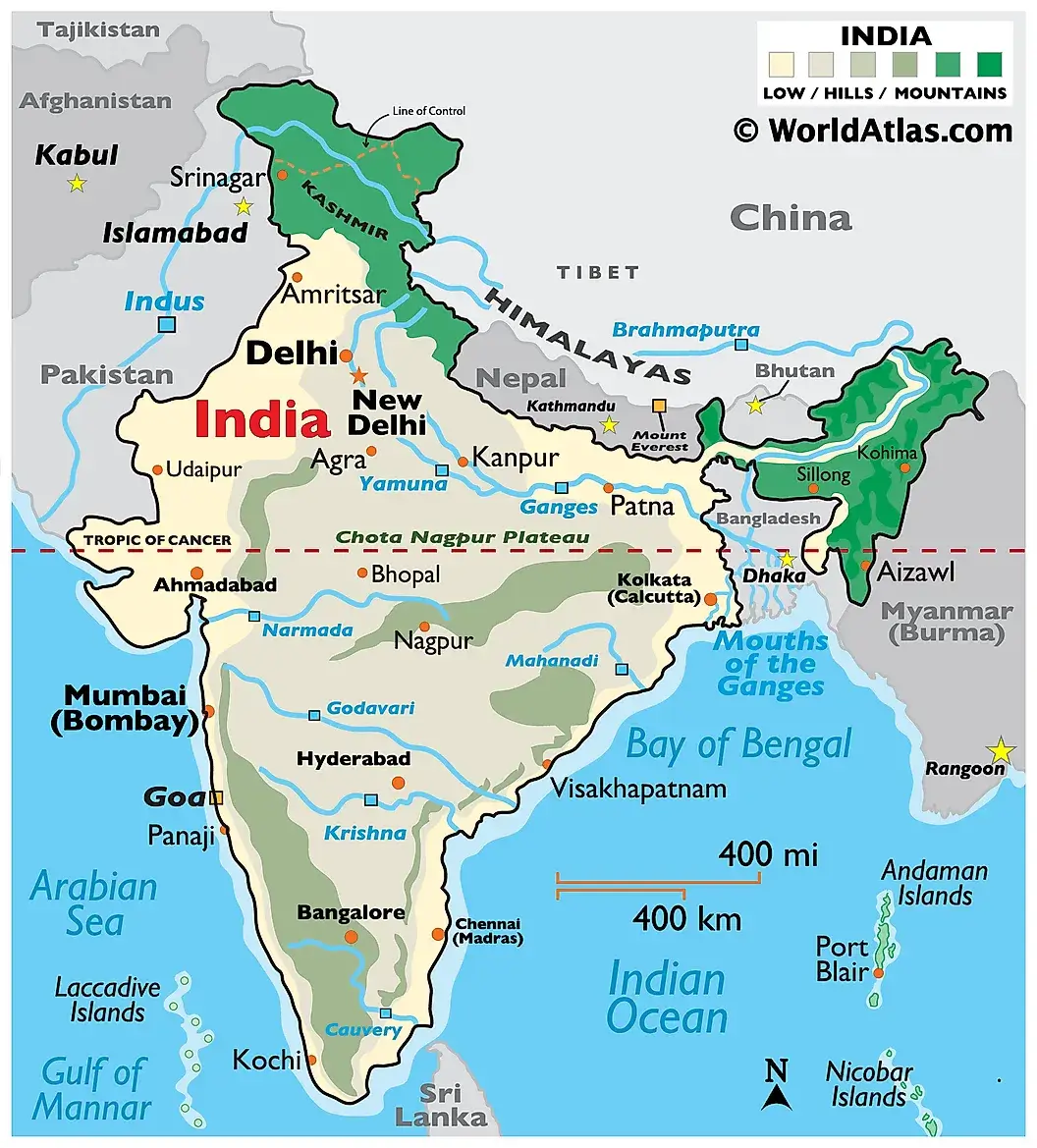
India is located in South Asia, bordered by Pakistan to the west, China and Nepal to the north, Bhutan to the northeast, and Bangladesh and Myanmar to the east. To the south, India is surrounded by the Indian Ocean. The country has a diverse topography that ranges from the snow-capped peaks of the Himalayas in the north to the coastal plains and desert regions in the west.
India’s geography can be broadly classified into six regions: the Himalayan Mountain Range, the Indo-Gangetic Plain, the Peninsular Plateau, the Desert Region (Rajasthan), the Coastal Plains, and the Islands of Andaman and Nicobar. The Himalayas, which include some of the world’s highest peaks such as Mount Everest, form a natural barrier between India and China. The vast river systems, including the Ganges, Yamuna, Brahmaputra, and Indus, support agriculture, while the Deccan Plateau in the south is known for its dry terrain and volcanic soil.
The climate varies from tropical in the south to temperate in the north, with a monsoon season that typically runs from June to September. This seasonal rain is crucial for agriculture, which is heavily dependent on the monsoon.
India is a federal parliamentary democratic republic, with a President serving as the head of state and a Prime Minister serving as the head of government. The President of India is elected by an electoral college, which includes members of both houses of Parliament and the elected members of the State Legislative Assemblies. However, the office of the President is largely ceremonial, with executive powers vested in the Prime Minister.
The Indian Parliament consists of two houses: the Lok Sabha (House of the People) and the Rajya Sabha (Council of States). Members of the Lok Sabha are directly elected by the people of India through general elections, which are held every five years. The Rajya Sabha represents the states of India and its members are elected by the elected members of the State Legislative Assemblies.
India’s political landscape is highly diverse, with several national and regional parties. The two largest political parties are the Indian National Congress (INC) and the Bharatiya Janata Party (BJP), with the latter currently being the dominant force in national politics. The country has a multi-party system, with regional parties playing a significant role in state-level elections.
India is also a member of several international organisations, including the United Nations, World Trade Organisation, and Commonwealth of Nations. It plays an active role in global diplomacy and is one of the world’s leading emerging powers.
India’s economy is the sixth-largest in the world by nominal GDP and the third-largest by purchasing power parity. The country has a mixed economy, characterised by a combination of traditional agricultural sectors, industrialisation, and a rapidly growing services sector. India is a leading global player in sectors such as information technology (IT), pharmaceuticals, biotechnology, and telecommunications.
Agriculture remains an important part of India’s economy, employing a significant portion of the population. The Green Revolution in the 1960s significantly boosted agricultural productivity, and India is now one of the largest producers of rice, wheat, and sugarcane in the world. However, the country faces challenges such as water scarcity, fragmented landholdings, and the need for further investment in rural infrastructure.
The services sector has been a major driver of India’s economic growth in recent decades. India is home to a burgeoning IT and software services industry, with cities like Bengaluru and Hyderabad becoming global tech hubs. The country’s vast and youthful workforce also contributes to its competitive advantage in the global labour market.
India has a large and growing middle class, which has been a key factor in the expansion of its domestic consumption and retail sectors. However, the country continues to grapple with significant income inequality, unemployment, and poverty in rural areas.
India is home to over 1.4 billion people, making it the second-most populous country globally. It is also one of the most linguistically diverse nations in the world, with 22 officially recognised languages and over 1,600 dialects. Hindi is the most widely spoken language, with English serving as an associate official language and being extensively used in business, government, and education.
India has a relatively young population, with a median age of around 28 years. The country is also experiencing rapid urbanisation, with millions migrating from rural areas to cities in search of better opportunities. The largest cities include Mumbai, Delhi, Bengaluru, and Kolkata, each of which is a hub of economic, cultural, and political activity.
India’s population is predominantly Hindu (approximately 80%), followed by Muslims (14%), Christians (2.3%), Sikhs (1.7%), and other religious minorities. India is constitutionally secular, with religious diversity being one of the country’s defining features.
India has a rich cultural heritage, shaped by thousands of years of history, religious traditions, and social diversity. Its culture is renowned for its contributions to philosophy, art, literature, music, and dance. Major world religions, such as Hinduism, Buddhism, Jainism, and Sikhism, originated in India, and the country continues to be a centre of spiritual practice.
Indian cuisine is varied and diverse, with regional specialities influenced by religion, geography, and historical trade routes. The country is also known for its distinctive art forms, including classical music and dance styles like Bharatanatyam, Kathak, and Odissi. Bollywood, the Hindi-language film industry, is a major cultural export and one of the world’s largest film industries.
India is also known for its architectural landmarks, including the Taj Mahal, Qutub Minar, and ancient temples like those at Khajuraho and Hampi. Festivals such as Diwali, Eid, Holi, and Christmas are celebrated with fervour across the country, reflecting the country’s religious diversity and cultural vibrancy.
India is a founding member of the Commonwealth of Nations, a voluntary association of countries, most of which were former territories of the British Empire. As one of the largest and most influential members, India plays an active role in the Commonwealth’s political, economic, and cultural initiatives.
The relationship between India and the Commonwealth has been significant since the country’s independence in 1947. India has contributed to the Commonwealth’s goals of promoting peace, democracy, and sustainable development. It participates in various Commonwealth programmes, including educational and cultural exchanges, and hosts the Commonwealth Games in 2010, a major event in international sport.
India also engages with the Commonwealth on issues related to climate change, trade, and human rights, continuing to be a key player in global affairs.
