
Commonwealth Portal is grateful to the following individual and business supporter, who has enabled us to maintain and expand the contents regarding Gabon.
The name “Gabon” originates from the Portuguese word “Gabão,” which means “cloak” or “hood.” This name was given by Portuguese explorers in the late 15th century when they arrived at the estuary of the Komo River. The shape of the river’s mouth, which widens before flowing into the Atlantic Ocean, was thought to resemble a hooded cloak, leading to the name. Over time, the Portuguese term “Gabão” was adapted into “Gabon” by French colonial administrators, who established control over the region in the 19th century.
Before European contact, Gabon was home to several indigenous ethnic groups, including the Fang, Punu, Myene, and Bakota. These groups had their own names for the land and its different regions. Many of these names reflected the geographical features, rivers, and cultural traditions of the local people. However, the colonial period led to the standardization of “Gabon” as the official name, which has persisted to this day.
During French colonization, Gabon was incorporated into French Equatorial Africa (Afrique Équatoriale Française, AEF), a federation of Central African territories controlled by France. The term “Gabonese” was later used to refer to the country’s people and cultural identity. After gaining independence from France on August 17, 1960, Gabon officially adopted the Republic of Gabon (République Gabonaise) as its full name.
Gabon is often referred to as “Africa’s Eden” due to its lush rainforests, rich biodiversity, and efforts to preserve its wildlife. This term has gained popularity in conservation and tourism circles, highlighting Gabon’s status as a leader in environmental protection. The country is also sometimes called “The Green Jewel of Africa” because of its vast tropical forests, which cover more than 85% of its land area.
Linguistically, Gabon’s official language is French, a legacy of its colonial past. French remains the dominant language in government, education, and business. However, the country is home to over 40 indigenous languages, including Fang, Myene, Punu, and Teke, which are widely spoken among different ethnic groups. Many Gabonese people are multilingual, speaking both French and their native languages in daily life.
The country’s motto, “Union, Travail, Justice” (which translates to “Unity, Work, Justice”), reflects Gabon’s national values and aspirations. This phrase is prominently displayed on Gabon’s official emblems, including the national coat of arms and currency. The Gabonese flag also symbolizes key aspects of the nation’s identity: green represents the country’s forests and natural wealth, yellow symbolizes the equatorial sun and national prosperity, and blue stands for the Atlantic Ocean, which plays a vital role in Gabon’s economy and geography.
In modern international contexts, Gabon is often associated with OPEC (Organization of the Petroleum Exporting Countries) due to its oil production, as well as CEMAC (Central African Economic and Monetary Community), which fosters regional economic cooperation. Despite its small population, Gabon plays a significant role in African diplomacy and environmental conservation, strengthening its global identity beyond its historical and linguistic roots.
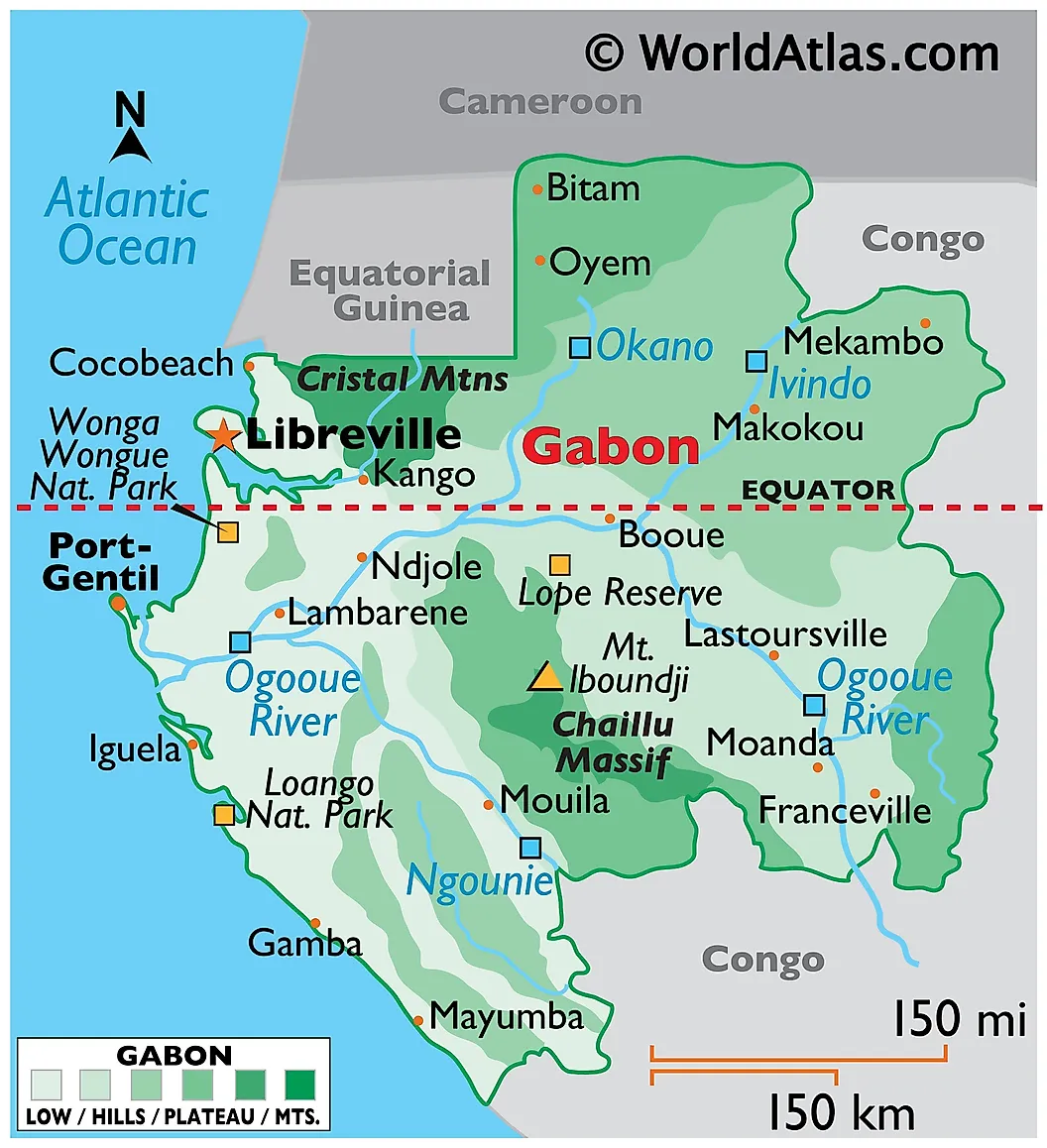
Gabon is a country located on the west coast of Central Africa, bordered by Equatorial Guinea to the northwest, Cameroon to the north, the Republic of the Congo to the east and south, and the Atlantic Ocean to the west. It covers an area of 267,667 square kilometers (103,347 square miles), making it roughly the size of New Zealand or the U.S. state of Colorado. Its location along the equator gives it a tropical climate, characterized by high humidity, warm temperatures, and significant rainfall throughout the year.
The country’s landscape is diverse and rich in natural beauty, consisting of coastal plains, rolling hills, and dense rainforests. The coastal region features sandy beaches and lagoons, with the capital, Libreville, situated along the Atlantic shoreline. Moving inland, the terrain becomes more hilly and forested, leading to the Cristal Mountains in the northwest and the Chaillu Mountains in the center, where Mount Iboundji, Gabon’s highest peak at 1,575 meters (5,167 feet), is located.
One of Gabon’s defining geographical features is its vast rainforest coverage, which accounts for over 85% of the country’s land area. This makes Gabon one of the most heavily forested nations in Africa and a crucial part of the Congo Basin, the second-largest rainforest in the world after the Amazon. These dense forests provide a habitat for a wide variety of wildlife, including forest elephants, gorillas, leopards, and numerous bird species.
Gabon is home to a network of 13 national parks, covering around 11% of its total land area, one of the highest proportions of protected land in the world. Loango National Park, often called “Africa’s Last Eden,” is famous for its unique combination of savannas, wetlands, and coastal ecosystems, where elephants and hippos can be seen roaming along the beaches. Ivindo National Park is known for its stunning waterfalls, particularly Kongou Falls, one of the most powerful cascades in Central Africa.
The Ogooué River, the longest river in Gabon at 1,200 kilometers (750 miles), dominates the country’s hydrography. It flows from the Republic of the Congo through Gabon and empties into the Atlantic Ocean. The river system is essential for transportation, fishing, and local livelihoods, supporting numerous communities along its banks. Other major rivers include the Ivindo, Nyanga, and Ngounié Rivers, which contribute to Gabon’s rich freshwater ecosystems.
Gabon’s coastline stretches for about 885 kilometers (550 miles) along the Atlantic Ocean, featuring a mix of sandy beaches, mangrove swamps, and estuaries. The coastal waters are rich in marine biodiversity, including sea turtles, dolphins, and humpback whales, which migrate to Gabon’s waters between June and September. The Corisco Bay Islands, located off the northern coast, are another significant geographical feature, known for their white sandy beaches and crystal-clear waters.
Due to its equatorial location, Gabon experiences two rainy seasons (from February to May and from October to December) and two dry seasons (from June to September and from December to January). This climate supports the lush vegetation and rich biodiversity that define Gabon’s unique geography, making it one of Africa’s most ecologically significant nations.
Gabon operates as a presidential republic, where the President of the Republic serves as both the head of state and head of government. The country’s political system is based on a unitary state model, meaning that power is centralized rather than shared among federal regions. The Constitution of Gabon, first adopted in 1991, has undergone multiple amendments to strengthen governance, maintain stability, and adapt to political transitions.
The executive branch is the most powerful arm of government. The President is elected by popular vote for a five-year term, following a constitutional amendment in 2023 that reduced the term from seven years. The President has broad authority, including appointing the Prime Minister, government ministers, and senior officials. Additionally, the President serves as the Commander-in-Chief of the Armed Forces, controls national defense policies, and has the power to dissolve the National Assembly under specific conditions.
The legislative branch consists of a bicameral Parliament, which includes the National Assembly and the Senate. Members of the National Assembly are elected by direct vote, while Senators are chosen by municipal councils and local officials. The legislature is responsible for passing laws, approving the national budget, and overseeing the executive branch. However, due to the historically strong role of the presidency, the legislative branch has often been perceived as playing a secondary role in governance.
The judicial branch in Gabon is based on French civil law traditions and is officially independent. The highest judicial authority is the Constitutional Court, which oversees constitutional matters and ensures laws comply with the national charter. Other important judicial institutions include the Court of Cassation, which handles criminal and civil cases, and the Council of State, which deals with administrative disputes. Despite formal independence, the judiciary has faced criticisms regarding its autonomy and susceptibility to executive influence.
Gabon has a multi-party political system, but for decades, power has been dominated by the Gabonese Democratic Party (Parti Démocratique Gabonais – PDG), which was the sole legal party until 1990, when the country transitioned to multi-party democracy. Political opposition has grown over the years, but elections have often been contested due to allegations of fraud, irregularities, and lack of transparency.
Local governance is structured into nine provinces, each administered by a governor appointed by the President. These provinces are further divided into departments, districts, and municipalities, with local officials responsible for regional administration and service delivery. However, much of the decision-making power remains centralized in the national government.
Gabon plays an active role in regional and international diplomacy. It is a member of several organizations, including the African Union (AU), the Economic Community of Central African States (ECCAS), the United Nations (UN), and the Organisation of Petroleum Exporting Countries (OPEC). The country has historically acted as a mediator in regional conflicts and promotes environmental diplomacy, particularly in climate change discussions and rainforest conservation efforts.
Overall, Gabon’s political structure is characterized by a strong executive branch, a developing multi-party democracy, and centralized governance, with ongoing efforts to promote greater transparency, accountability, and political inclusiveness.
Gabon has a resource-rich economy, primarily driven by oil production, mining, and timber exports. It is classified as an upper-middle-income country, largely due to its high GDP per capita compared to other African nations. However, despite its wealth in natural resources, economic inequality remains a challenge, with a significant portion of the population experiencing unemployment and poverty. The government has been actively working to diversify the economy and reduce dependence on oil by investing in other sectors such as agriculture, tourism, and digital technology.
Oil and Gas
The oil sector is the backbone of Gabon’s economy, contributing nearly 50% of GDP and over 80% of export revenues. The country is a member of the Organization of Petroleum Exporting Countries (OPEC) and has significant offshore and onshore oil reserves. The major oil fields are located in the Port-Gentil region, with companies such as TotalEnergies, Perenco, and Shell playing key roles in extraction and export. However, declining oil reserves and fluctuating global oil prices have prompted Gabon to seek alternative sources of revenue.
Mining
Gabon is one of the world’s largest producers of manganese, a key metal used in steel production. The Moanda Mine, operated by Compagnie Minière de l’Ogooué (COMILOG), produces some of the highest-quality manganese globally. Other important minerals include gold, iron ore, uranium, and phosphate, with ongoing government efforts to attract foreign investment in mining.
Forestry and Timber
With over 85% of Gabon covered by forests, the timber industry is a crucial sector. The government has introduced policies to promote sustainable logging and local processing, banning the export of raw logs to encourage domestic wood processing industries. Gabon is a global leader in Okoumé wood production, which is widely used for plywood manufacturing.
Agriculture and Fisheries
The agriculture sector remains underdeveloped, contributing only a small fraction to GDP. Most food is imported, increasing dependency on foreign markets. However, the government is promoting agricultural development projects to achieve food security and reduce reliance on imports. Key crops include cassava, plantains, cocoa, and coffee. Gabon’s fishing industry is also growing, with efforts to develop sustainable fisheries and aquaculture.
Tourism and Services
Gabon is positioning itself as a high-end ecotourism destination, leveraging its 13 national parks, pristine beaches, and rich wildlife. Loango National Park, known for its “surfing hippos” and elephant sightings, is a major attraction. The government aims to increase investment in tourism infrastructure, but challenges such as high costs and limited accessibility have slowed growth.
Despite its resource wealth, Gabon faces issues such as youth unemployment, economic inequality, and reliance on oil revenues. To address this, the government launched the Emerging Gabon Strategic Plan (Plan Stratégique Gabon Émergent – PSGE), which focuses on industrialization, infrastructure development, and digital transformation. Investments in technology parks, renewable energy, and financial services aim to create a more diversified and resilient economy.
With a focus on sustainability, economic reform, and regional integration, Gabon is working toward becoming a modern, diversified economy that can sustain long-term growth and reduce dependency on its natural resources.
Gabon has a population of approximately 2.3 million people, making it one of the least densely populated countries in Africa. With a land area of 267,667 square kilometers (103,347 square miles), the population density is relatively low, at around nine people per square kilometer. The majority of the population is concentrated in urban areas, particularly in the capital, Libreville, and the economic hub, Port-Gentil. Over 87% of Gabonese people live in cities, reflecting a high rate of urbanization compared to other African nations.
Gabon is home to over 40 ethnic groups, with the Fang being the largest, comprising around 32% of the population. Other major ethnic groups include the Punu, Nzebi, Myene, Kota, and Teke, each contributing to the country’s rich cultural diversity. Despite ethnic differences, Gabon has historically avoided ethnic conflicts, with intermarriage and national unity policies helping to maintain social stability.
The official language of Gabon is French, a legacy of colonial rule. It is used in government, education, business, and the media. In addition, several indigenous languages are widely spoken, including Fang, Myene, Punu, and Teke. Many Gabonese people are multilingual, often speaking their ethnic language at home while using French in formal settings. In recent years, there has been a push to preserve indigenous languages through cultural programs and education.
Christianity is the dominant religion, with around 75-80% of the population identifying as Christian. Among them, Roman Catholics make up the largest group, followed by Protestants and Evangelicals. The influence of Christianity is visible in the country’s religious institutions, celebrations, and architecture.
Traditional African religions, particularly Bwiti, are also practiced, often in combination with Christianity. Bwiti is a spiritual belief system rooted in ancestor worship, nature reverence, and the use of the sacred iboga plant. It is particularly significant among the Fang and Mitsogo ethnic groups. A small percentage of the population, around 6-10%, follows Islam, mostly among West African immigrant communities.
Gabon has a young population, with a median age of about 22 years. Over 60% of the population is under the age of 25, reflecting high birth rates. However, population growth is moderate, estimated at around 2.3% per year. The country’s fertility rate has been declining, currently averaging 3.5 children per woman, as urbanization, education, and economic factors influence family sizes.
Gabon has one of the highest literacy rates in Africa, at around 89%. Education is compulsory for children between 6 and 16 years old, and the government provides free primary and secondary schooling. Gabon’s largest university, Université Omar Bongo in Libreville, along with technical institutions, plays a key role in higher education. However, challenges remain in terms of education quality, access to rural schools, and job opportunities for graduates.
Gabon has attracted migrants from neighboring countries, especially from Cameroon, Chad, Nigeria, and the Republic of the Congo, due to its strong economy. Many immigrants work in construction, domestic labor, and retail. The urban population continues to grow, with Libreville and Port-Gentil being the most densely populated areas, creating challenges in housing, infrastructure, and public services.
Gabon’s demographics reflect a young, urbanized, and culturally diverse society with strong educational and religious traditions. While the country enjoys relative stability, addressing economic disparities, urban infrastructure, and youth employment will be essential for sustainable growth in the future.
Gabon’s culture is a rich blend of indigenous traditions, colonial influences, and modern global elements. Despite its small population, the country boasts a diverse ethnic, linguistic, and artistic heritage, shaped by its over 40 ethnic groups. While modernization and urbanization have transformed many aspects of daily life, traditional customs remain deeply rooted in music, dance, art, and spirituality.
Gabon’s largest ethnic group, the Fang, constitutes around 32% of the population, followed by other significant groups like the Punu, Nzebi, Myene, and Kota. Each ethnic group has its own language, customs, and traditional practices, contributing to the nation’s vibrant cultural identity. While French is the official language and widely spoken in urban areas, indigenous languages such as Fang, Myene, and Punu remain essential for communication in rural communities.
Although Christianity is dominant, traditional African spiritual beliefs play a crucial role in Gabonese culture. The Bwiti religion, primarily practiced by the Fang and Mitsogo peoples, is one of the most famous indigenous spiritual systems. Bwiti ceremonies involve music, dance, and the ritual use of iboga, a hallucinogenic plant considered sacred for its ability to connect individuals with the spirit world. This practice is now recognized globally and has influenced modern therapeutic research.
Music is at the heart of Gabonese culture, blending traditional rhythms with modern genres. Traditional music incorporates drums, balafons (a wooden xylophone), harps, and mouth bows. The Mvet harp, played mainly by the Fang people, is a crucial instrument in storytelling and oral history.
Dance is an essential part of cultural celebrations, religious rituals, and social events. Some of the most well-known dances include:
Ikoku – a lively dance performed by the Punu people, often accompanied by acrobatics and colorful masks.
Elombo – a spiritual dance that symbolizes communication with ancestors.
Ndjembé – a celebratory dance performed during communal gatherings.
Modern Gabonese musicians have gained international recognition by incorporating Afropop, reggae, and hip-hop into traditional sounds. Artists like Oliver N’Goma and Patience Dabany have popularized Gabonese music worldwide.
Gabonese art is highly respected, particularly its wood carvings and masks, which hold spiritual and symbolic significance. The Kota and Fang peoples are renowned for their stylized wooden masks and reliquary figures, which were historically used in ancestor worship and initiation ceremonies. These intricate artworks have influenced European artists, including Pablo Picasso and Henri Matisse.
Gabonese cuisine is a blend of local ingredients and French culinary influences. Staple foods include cassava, plantains, yams, and rice, often served with grilled fish, chicken, or bush meat. Popular dishes include:
Poulet Nyembwe – chicken cooked in a rich palm nut sauce, considered the national dish.
Brochettes – skewered and grilled meat, similar to kebabs.
Poisson Salé – salted fish served with vegetables and spices.
Despite rapid urbanization, Gabon continues to celebrate its traditions through festivals, art exhibitions, and national holidays. Events like the Libreville International Film Festival and the Abeti Cultural Festival showcase Gabon’s evolving cultural scene.
Gabon’s culture reflects a harmonious blend of traditional heritage and modern innovation, preserving its unique identity while embracing global influences. Whether through music, dance, art, or cuisine, Gabon’s rich cultural legacy continues to thrive.
Gabon officially joined the Commonwealth of Nations on June 25, 2022, becoming one of the newest members and one of the few non-former British colonies to be admitted. This historic move was part of Gabon’s strategic efforts to diversify its international partnerships, strengthen its diplomatic ties, and enhance economic cooperation with English-speaking nations. The decision to join the Commonwealth reflects the country’s commitment to democratic values, economic reform, and global integration.
Unlike most Commonwealth members, Gabon was never a British colony; instead, it was a former French colony that gained independence in 1960. However, several factors motivated its decision to join the 56-nation bloc:
Diplomatic and Political Benefits – Membership provides Gabon with greater international influence, allowing it to participate in global discussions on democracy, human rights, and sustainable development.
Economic Diversification – Gabon seeks to reduce its dependence on French economic ties by expanding trade and investment opportunities with English-speaking countries such as the United Kingdom, Canada, and Australia.
Education and Language Development – Joining the Commonwealth encourages the promotion of English language education, which is becoming increasingly important for business, diplomacy, and employment.
Shared Global Goals – Gabon aligns with Commonwealth priorities in areas such as climate change action, environmental conservation, and governance reforms.
As a Commonwealth member, Gabon is expected to uphold the Commonwealth Charter, which promotes democracy, rule of law, gender equality, and human rights. The government has initiated political and legal reforms to improve transparency, electoral processes, and governance structures. Gabon has also committed to strengthening its anti-corruption measures, enhancing press freedom, and ensuring a more inclusive political system.
Gabon views the Commonwealth as a platform for economic growth, trade expansion, and foreign investment. The country is looking to attract English-speaking investors in key sectors such as:
Oil and Gas – Seeking partnerships for sustainable energy projects.
Forestry and Agriculture – Promoting responsible logging and agribusiness ventures.
Tourism – Positioning itself as an eco-tourism hub for international visitors.
Additionally, Gabon aims to leverage Commonwealth connections to develop its digital economy, infrastructure projects, and financial services sector.
Despite joining the Commonwealth, Gabon remains closely tied to France, its former colonial power and main economic partner. However, this move signals a broader shift in Gabon’s foreign policy, aiming for a more diversified and balanced international approach. Gabon also maintains strong ties with the African Union, the United Nations, and the Economic Community of Central African States (ECCAS).
