
The name “Fiji” is derived from the Tongan pronunciation of the indigenous name of the islands, Viti, which the Fijians used to refer to themselves. The term Viti is thought to have originated from the Austronesian-speaking peoples who originally settled the islands. The British mispronounced Viti as Fiji when they arrived in the 19th century, and the name has since stuck internationally.
The people of Fiji are commonly referred to as Fijians. The term Fijian typically refers to individuals of indigenous Fijian descent, but in contemporary Fiji, it is often used to describe all citizens of the country, regardless of their ethnic background. The three main ethnic groups in Fiji are indigenous Fijians, Indo-Fijians (descendants of Indian indentured labourers brought to Fiji in the late 19th and early 20th centuries), and a minority of other ethnicities, including Rotumans, Europeans, and Pacific Islanders.
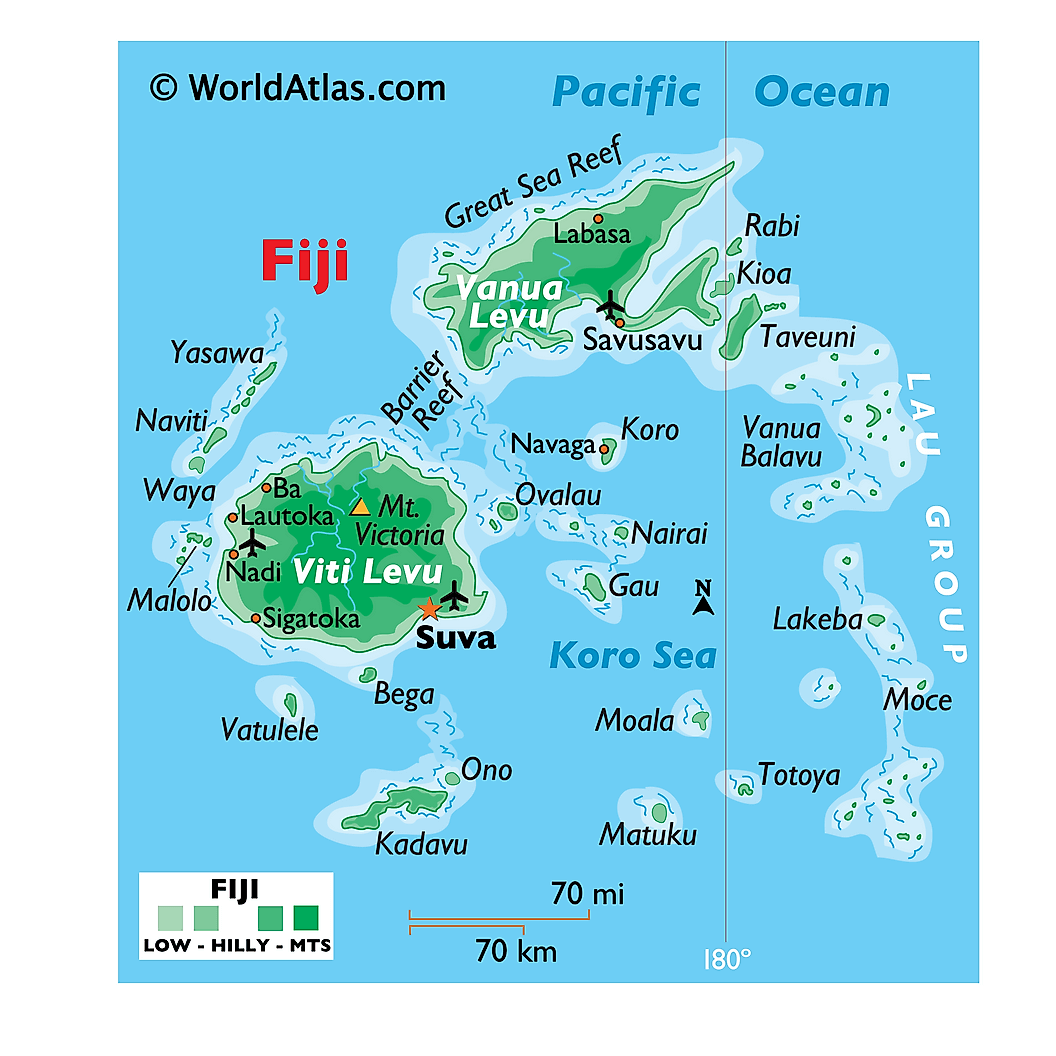
Fiji is an archipelago comprising approximately 330 islands, of which about 100 are inhabited. The two main islands are Viti Levu and Vanua Levu, which together make up 87% of the country’s total land area. Fiji’s total land area is approximately 18,300 square kilometres, with a coastline that stretches for more than 1,500 kilometres.
The islands of Fiji are located in the South Pacific Ocean, about 2,000 kilometres north-east of New Zealand and 3,000 kilometres south of Hawaii. The nation lies on the Pacific Ring of Fire, which makes it prone to volcanic activity and earthquakes, though most of its islands are not volcanically active today. The islands feature a tropical climate, with distinct wet and dry seasons, and are particularly vulnerable to natural disasters such as cyclones and flooding.
The landscape is dominated by rugged mountains, rainforests, and coastal plains. Fiji is also renowned for its coral reefs, which are among the most diverse in the world. These marine ecosystems, along with Fiji’s pristine beaches and clear lagoons, are vital to the nation’s tourism industry and biodiversity.
Fiji operates as a parliamentary democracy with a president as the ceremonial head of state and a prime minister as the head of government. The president, who is elected by the Electoral College, serves a largely symbolic role, while the prime minister holds executive power and is appointed by the parliament.
Fiji has experienced periods of political instability, marked by military coups and ethnic conflict. The first coup took place in 1987, when indigenous Fijian nationalist forces overthrew the elected government, which was dominated by Indo-Fijian political leaders. A second coup occurred in 2000, when armed rebels briefly held the country’s parliament. In 2006, another military coup was led by Frank Bainimarama, who assumed control of the country and later became its prime minister.
In 2013, Fiji introduced a new constitution that promised equal representation for all ethnic groups and aimed to reduce the influence of ethnic divisions in politics. General elections were held in 2014, followed by a second round in 2018, marking a return to democratic rule. However, tensions remain between the indigenous Fijian and Indo-Fijian populations, and political reforms continue to be a focal point in the country’s development.
Fiji is a member of various international organisations, including the United Nations, the Pacific Islands Forum, and the Commonwealth of Nations. It has been an advocate for environmental issues, particularly in the context of climate change, and has actively participated in global efforts to combat environmental degradation.
Fiji’s economy is classified as a developing economy and is heavily reliant on agriculture, tourism, and remittances from Fijians working abroad. The country’s economic output is largely based on the export of sugar, mineral water, and garments. Sugar is particularly important, as Fiji has a long history of sugarcane cultivation dating back to the colonial era.
Tourism is a major contributor to the economy, with the island nation attracting visitors for its beaches, resorts, and rich cultural experiences. Fiji has sought to diversify its tourism offerings, focusing on ecotourism and adventure tourism. The government has invested heavily in infrastructure, such as roads and airports, to support the growth of the tourism sector.
In recent years, the Fijian government has made efforts to diversify the economy by promoting sectors such as manufacturing, fisheries, and renewable energy. Fiji is also exploring the potential of its natural resources, including geothermal and hydroelectric power, to reduce its dependency on imported fossil fuels. However, the country remains vulnerable to external shocks, particularly in the areas of commodity prices, natural disasters, and climate change.
Despite these challenges, Fiji has demonstrated resilience and continues to experience modest economic growth. Its economic development, however, remains constrained by political instability, limited natural resources, and regional competition.
Fiji has a population of approximately 900,000 people, with the majority residing on the two main islands of Viti Levu and Vanua Levu. The population is ethnically diverse, with indigenous Fijians (iTaukei) constituting about 56% of the population, Indo-Fijians making up around 37%, and smaller communities of Pacific Islanders, Europeans, and others.
The population density varies, with most people living in urban areas such as Suva, the capital city, and Nadi, a key tourism hub. Rural areas, particularly in the outer islands, are less densely populated, and many Fijians rely on subsistence farming or fishing for their livelihoods.
Fiji has a relatively young population, with a median age of around 27 years. The country has experienced significant migration, both in terms of emigration (especially to countries like New Zealand, Australia, and the United States) and immigration (especially from India and other Pacific islands). The Fijian government has sought to attract skilled workers back to the country through incentives for professionals and entrepreneurs.
The official language of Fiji is English, although Fijian and Hindi are also widely spoken. English is used in government, education, and business, while Fijian is the language of the indigenous population and Hindi is spoken by many Indo-Fijians.
Fijian culture is a blend of indigenous Fijian, Indian, and European influences, reflecting the country’s colonial past and its multi-ethnic population. The traditional Fijian way of life is centred around communal living and respect for authority, particularly the roles of elders and chiefs. Social gatherings, such as the sevusevu (a traditional welcoming ceremony involving the presentation of yaqona, or kava), are an important part of Fijian culture.
Music, dance, and art play a significant role in the cultural life of Fiji. Traditional Fijian dance, such as the meke, is a vibrant form of expression, often performed during ceremonial events. Fiji’s unique mix of cuisines reflects its cultural diversity, with Indian, Chinese, and Fijian foods commonly served together. Dishes like roti, curries, lovo (meat and vegetables cooked in an underground oven), and kava are important parts of Fijian culinary traditions.
Fiji celebrates various festivals, including the Hindu festival of Diwali, Christian holidays such as Christmas and Easter, and the indigenous Fijian celebration of Bula Day.
Fiji has a strong historical connection with the Commonwealth of Nations, having been a British colony until 1970. It became an independent nation within the Commonwealth, and its political, social, and economic development continues to benefit from its membership in the organisation.
As a member of the Commonwealth, Fiji participates in regional and international forums focused on issues such as climate change, economic development, and human rights. The Commonwealth has also played a role in supporting Fiji during times of political instability, particularly following the coups of 1987 and 2000.
Fiji’s relationship with the Commonwealth has been vital for its diplomatic and economic connections, providing the country with access to development assistance, educational opportunities, and trade partnerships.
