
The name “Brunei” is believed to derive from the Sanskrit word “Vibhajana,” which means “to divide” or “divide into parts.” The term “Darussalam,” meaning “Abode of Peace” in Arabic, was added later and is part of the country’s official name, Brunei Darussalam. The use of the Arabic term reflects the nation’s identity as a Muslim-majority state, with Islam being central to both its governance and culture.
The people of Brunei are known as “Bruneians,” and the country’s official language is Malay, although English is widely spoken and understood. Islam is the state religion, and the Sultan of Brunei holds the titles of both head of state and head of government.
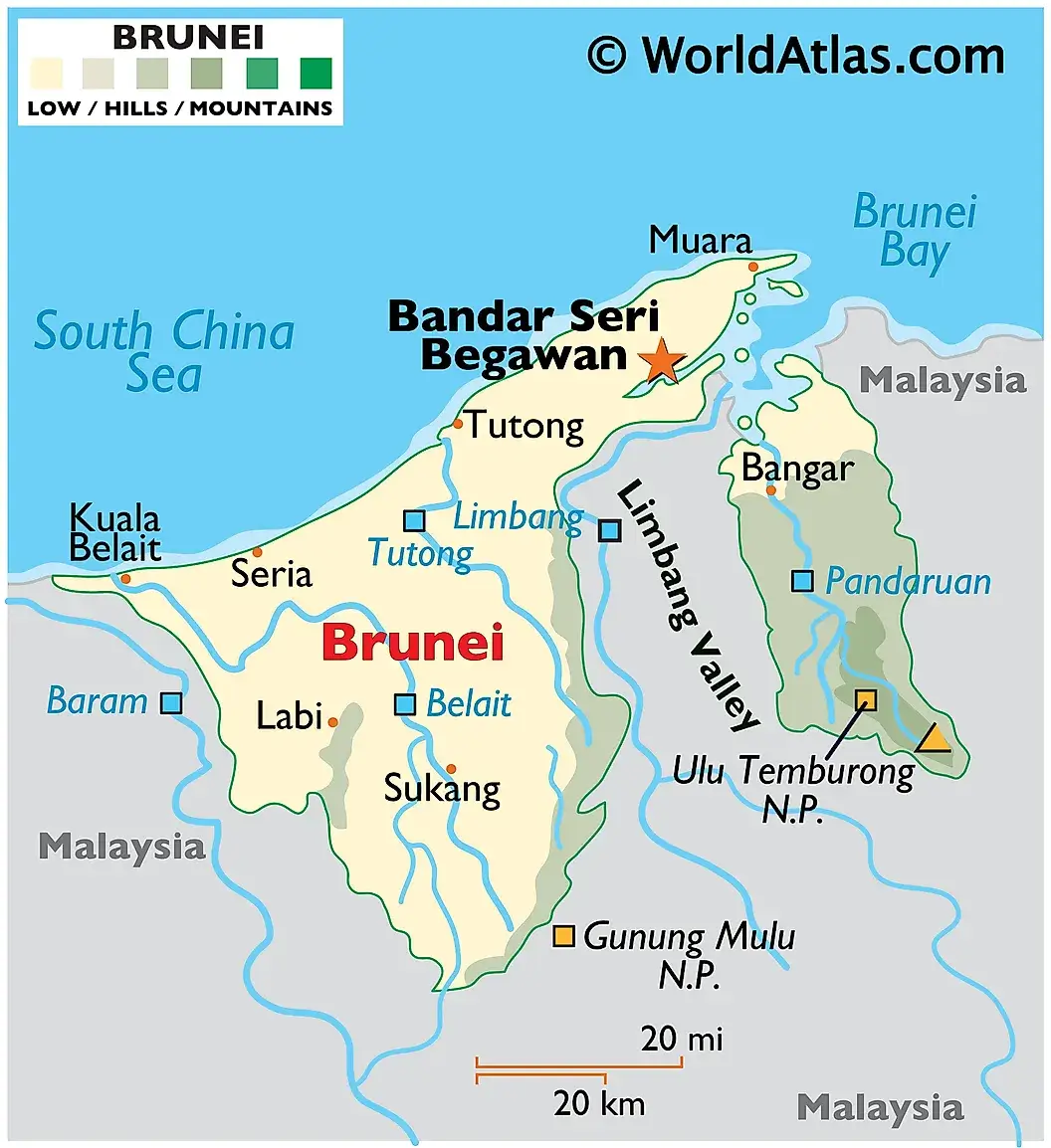
Brunei is located on the island of Borneo, which is shared by three countries: Brunei, Malaysia, and Indonesia. The country is uniquely situated as a small enclave, completely surrounded by the Malaysian state of Sarawak except for its northern coastline along the South China Sea.
The terrain of Brunei is characterised by mountainous areas, particularly in the eastern part of the country, which are covered in dense tropical rainforests. Brunei’s landscape also features lowland plains, which are conducive to the development of the nation’s oil industry. The country’s climate is tropical, with high humidity and temperatures typically ranging from 23°C to 32°C. Brunei experiences heavy rainfall, particularly during the wet season from November to February.
Brunei has an extensive river system, with the Brunei River being the largest and serving as an important transportation route. The country also has significant natural reserves of forests, oil, and gas, which play a central role in its economy.
Brunei is an absolute monarchy, and the Sultan is both the head of state and the head of government, holding considerable power over the executive, legislative, and judicial branches. Sultan Hassanal Bolkiah, the longest-reigning monarch in the world, has ruled Brunei since 1967. The Sultan’s governance is characterised by his direct control over the government and military, as well as his role as the religious leader of the nation.
The political structure of Brunei also includes a state council, known as the Majlis Mesyuarat Negara, which provides advice to the Sultan but has limited legislative power. There are no political parties in Brunei, and elections for the National Assembly are not held; the Sultan appoints the members of the Assembly and other key officials.
In 2014, Brunei introduced a new Sharia-based penal code, marking a significant shift towards greater Islamic law in the country. This move sparked some controversy, particularly regarding human rights concerns, but it reflected the Sultan’s desire to reinforce the Islamic identity of Brunei.
Brunei has one of the highest GDP per capita rates in the world, largely due to its vast oil and natural gas reserves. The country is a leading exporter of oil and liquefied natural gas (LNG), with these industries accounting for more than half of its GDP and around 90% of its export revenues. The wealth generated from these resources has allowed Brunei to maintain a high standard of living and a strong welfare system, including free healthcare and education for its citizens.
Brunei’s economy is heavily reliant on oil and gas, which has led to efforts to diversify its economy. The government has invested in other sectors such as finance, tourism, and agriculture, but oil and gas remain dominant. Brunei has also established a sovereign wealth fund, the Brunei Investment Agency (BIA), which invests the country’s oil revenues in various international markets to ensure long-term economic stability.
While the economy is highly prosperous, Brunei faces the challenge of diversifying away from its dependency on oil, especially as global energy markets change and environmental concerns rise.
Brunei has a small, ethnically diverse population, with the majority of people identifying as Malay, which forms the basis of the national culture and language. There are also significant populations of Chinese and indigenous groups, such as the Iban, Dusun, and Murut. While the majority of Bruneians are Muslim (Sunni Islam), there are also small Christian, Buddhist, and indigenous communities in the country.
The population of Brunei is around 460,000, and the country has a relatively high standard of living, with access to free healthcare, education, and other government services. Life expectancy in Brunei is among the highest in the world, reflecting the country’s wealth and well-developed healthcare system.
Despite the small population, Brunei has a significant expatriate community, particularly in sectors such as oil, gas, and construction. Foreign workers, mainly from Malaysia, the Philippines, and other Southeast Asian nations, make up a considerable portion of the workforce in Brunei
Brunei’s culture is deeply influenced by its Malay heritage and Islamic traditions, which are reflected in the country’s architecture, festivals, and daily life. The culture is centred around respect for authority, religious observance, and traditional values.
Islam plays a central role in shaping cultural practices in Brunei. The country observes the five pillars of Islam, with daily prayers, fasting during Ramadan, and annual pilgrimages to Mecca. Brunei also celebrates important Islamic festivals such as Eid al-Fitr, Eid al-Adha, and the Islamic New Year.
In terms of arts, Brunei has a strong tradition of performing arts, particularly in music and dance. Traditional Malay music, such as the gamelan and sabarang, is popular, while Brunei’s handicrafts, such as songket (woven textiles) and wood carvings, reflect the country’s artisanal heritage.
Bruneian cuisine is characterised by its use of fresh local ingredients, with rice being the staple food. Dishes such as nasi lemak (coconut rice with sambal, peanuts, and boiled egg) and satay (grilled skewered meat) are common in Bruneian meals. The cuisine also features influences from Malay, Chinese, and Indian culinary traditions.
Brunei Darussalam is a member of the Commonwealth of Nations, a political association of former British colonies. Although Brunei was never formally colonised, it was a British protectorate from 1888 until its independence in 1984. Since independence, Brunei has maintained strong ties with the Commonwealth, participating in Commonwealth summits and collaborating with other member countries on a range of issues, from trade to sustainable development.
Brunei’s relationship with the Commonwealth is also symbolic of its broader commitment to international cooperation. As a small but wealthy nation, Brunei plays an active role in regional organisations such as the Association of Southeast Asian Nations (ASEAN) and the Asia-Pacific Economic Cooperation (APEC).
