
Commonwealth Portal is grateful to the following individual and business supporter, who has enabled us to maintain and expand the contents regarding Bangladesh.
The name “Bangladesh” is derived from the Bengali word “Bangla,” referring to the Bengali-speaking region, and the Persian suffix “-desh,” which means “land” or “country.” Thus, “Bangladesh” translates to “Land of the Bengalis.” The term “Bengali” itself is a historical reference to the ethnic group and language native to the region. Bangladesh’s national language is Bengali (Bangla), and it serves as the primary means of communication across the country.
While the term “Bangladesh” broadly refers to the entire country, it is often used to distinguish it from the Indian state of West Bengal, where Bengali-speaking people also reside. The term “Bangladeshi” refers to the people of Bangladesh, both in terms of nationality and ethnicity.
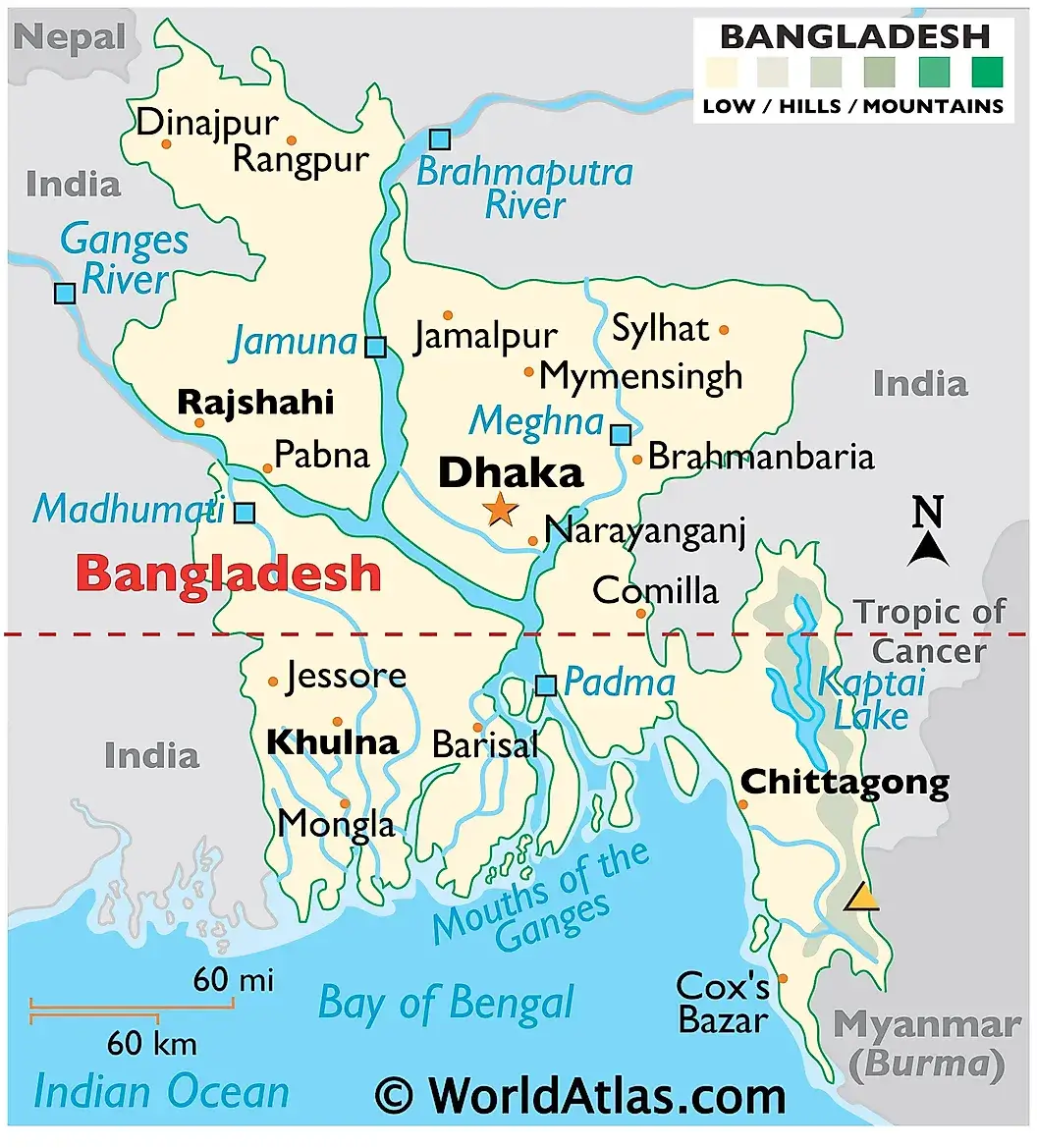
Bangladesh is situated on the Bay of Bengal and is part of the Ganges-Brahmaputra Delta, one of the largest river deltas in the world. The country’s geography is characterised by flat, low-lying land, with the majority of the country being below 10 metres above sea level. This makes Bangladesh extremely vulnerable to flooding, storm surges, and rising sea levels, issues that are exacerbated by climate change.
The country is crisscrossed by a vast network of rivers, including the Ganges (Padma), Brahmaputra (Jamuna), and Meghna rivers. These rivers provide fertile soil for agriculture but also pose significant flood risks during the monsoon season.
Bangladesh shares borders with India on the west, north, and east, and with Myanmar in the southeast. The Bay of Bengal to the south provides access to international shipping routes. The country has a tropical monsoon climate, with distinct wet and dry seasons. The monsoon season, from June to October, brings heavy rainfall and frequent flooding, while the dry season lasts from November to March.
Bangladesh is a parliamentary democracy, with a multi-party system. The political system is based on the Constitution of Bangladesh, which was adopted in 1972. The President is the ceremonial head of state, while executive power rests with the Prime Minister, who is the leader of the majority party in the Jatiyo Sangsad (National Parliament). The President is elected by the Parliament for a five-year term, and the Prime Minister is the leader of the party or coalition with the most seats in the legislature.
The political landscape of Bangladesh has been dominated by two major political parties: the Awami League (AL) and the Bangladesh Nationalist Party (BNP). The Awami League, led by Sheikh Hasina, is generally seen as the more secular party, while the BNP, led by the Zia family, has tended to have a more conservative, nationalist orientation. The rivalry between these two parties has been a defining feature of Bangladeshi politics, and the country has experienced political instability, protests, and violence related to their competition for power.
Bangladesh has also experienced several periods of military rule, most recently in the 1970s and 1980s, although the military has remained influential in the country’s politics.
Bangladesh has experienced rapid economic growth over the past few decades, with an average growth rate of around 6% per year. The country’s economy is predominantly based on agriculture, textiles, and remittances. The ready-made garment (RMG) sector is the cornerstone of Bangladesh’s economy, making the country the second-largest exporter of garments in the world, after China.
Agriculture remains vital, employing a significant portion of the population, although its share of the GDP has declined as the country has industrialised. Major agricultural products include rice, jute, tea, and fish. Bangladesh is also one of the largest producers of shrimp globally.
The services sector, particularly telecommunications and banking, has seen significant growth. Bangladesh has also benefitted from the remittances of its large diaspora, particularly from the Middle East and Southeast Asia.
Despite these successes, Bangladesh faces significant challenges, including income inequality, widespread poverty, infrastructure deficits, and environmental vulnerability due to flooding, cyclones, and sea-level rise. The country is also working to diversify its economy, focusing on sectors like technology, pharmaceuticals, and renewable energy.
As of 2023, Bangladesh has a population of approximately 170 million, making it the eighth-most populous country in the world. The population is young, with a median age of around 27 years, and it has grown rapidly over the past several decades due to improvements in healthcare and a decline in mortality rates.
The majority of Bangladeshis are ethnic Bengalis, and the official language, Bengali (Bangla), is spoken by the vast majority of the population. Bangladesh is predominantly Muslim (around 90%), with Hindus being the largest religious minority. There are also small communities of Buddhists and Christians.
Urbanisation in Bangladesh has accelerated in recent years, with Dhaka and Chittagong being the largest and most rapidly growing cities. However, the country still has a large rural population, and much of its economy remains reliant on agriculture.
Bangladesh has a rich and diverse cultural heritage, influenced by various traditions and civilisations throughout history. Bengali culture is known for its contributions to literature, art, music, and film. The Bengali Renaissance, which began in the 19th century, led to a flourishing of literature, philosophy, and social reform.
Rabindranath Tagore, a Nobel laureate in literature, is perhaps the most famous figure in Bengali cultural history. His works, including the national anthems of both India and Bangladesh, have left an enduring mark on the culture of the region. In addition to Tagore, the works of Kazi Nazrul Islam, the national poet of Bangladesh, are highly influential.
Bangladesh’s traditional music includes folk music, classical music, and modern pop music. The country also has a rich tradition of visual arts, including painting, sculpture, and embroidery. Festivals such as Pohela Boishakh (Bengali New Year), Durga Puja, and Eid al-Fitr are important cultural events celebrated by the population
Bangladesh is a member of the Commonwealth of Nations, a political association of former British colonies, though it was never formally part of the British Empire as a separate entity. After its independence in 1971, Bangladesh joined the Commonwealth to foster international cooperation, particularly with regard to trade, education, and cultural exchange.
As a Commonwealth member, Bangladesh participates in various initiatives and events, including the Commonwealth Games and meetings of the Commonwealth Heads of Government. The country has also benefited from aid and technical assistance provided by the Commonwealth, particularly in areas like education, healthcare, and disaster management.
