
Commonwealth Portal is grateful to the following individual and business supporter, who has enabled us to maintain and expand the contents regarding Kingdom of Eswatini.
The Kingdom of Eswatini, formerly known as Swaziland, derives its name from King Mswati II, a prominent 19th-century monarch who significantly expanded and unified the Swazi territory. The term “Eswatini” translates to “land of the Swazis” in the siSwati language, reflecting the nation’s deep-rooted cultural identity.
Historically, the Swazi people, originally known as the Ngwane, settled near the Pongola River before migrating northward under the leadership of King Ngwane III. They established their capital at Shiselweni, laying the foundation for the Swazi nation. The name “Swaziland” was an anglicised version used during British colonial rule, adhering to the convention of adding the suffix “-land” to denote territories, similar to “Nyasaland” (now Malawi) and “Bechuanaland” (now Botswana). Wikipedia
On 19 April 2018, during the 50th anniversary celebrations of Swazi independence, King Mswati III announced the official renaming of the country to the Kingdom of Eswatini. This change aimed to reclaim the nation’s cultural heritage and reduce confusion with Switzerland, as the names were often mistakenly interchanged internationally. Wikipedia
The renaming aligns with a broader trend among African nations reclaiming indigenous names post-independence, symbolising a move away from colonial legacies. For instance, Rhodesia became Zimbabwe, and the Gold Coast was renamed Ghana. In Eswatini’s case, the change was also intended to foster national pride and assert the country’s identity on the global stage.
The transition to the new name has been implemented across various sectors, including government institutions, educational materials, and international organisations. However, some entities and individuals continue to use “Swaziland,” particularly in historical contexts or due to familiarity. The dual usage during the transition period reflects the challenges inherent in altering a country’s official designation, especially considering the widespread recognition of the former name.
Linguistically, the prefix “e-” and the suffix “-ini” in “Eswatini” are characteristic of the siSwati language, denoting location. This morphological structure emphasises the nation’s identity as the homeland of the Swazi people. The siSwati language, a Bantu language of the Nguni group, is integral to the country’s cultural expression and is one of Eswatini’s official languages alongside English.Wiktionary
The name change has also influenced the country’s international relations and branding. Diplomatic missions, international agreements, and global organisations have adapted to the new nomenclature, ensuring consistency with the nation’s official identity. Tourism marketing campaigns have embraced “Eswatini,” promoting the country’s unique cultural and natural attractions under its authentic name.
Domestically, the renaming has been incorporated into educational curricula, with textbooks and teaching materials updated to reflect “Eswatini.” This initiative aims to instil a sense of national pride among the youth and reinforce the significance of cultural heritage. Public signage, currency, and official documents have also been revised, marking a comprehensive shift to the nation’s indigenous identity.
In summary, the etymology and terminology of Eswatini are deeply intertwined with the nation’s history, culture, and identity. The adoption of the name “Eswatini” signifies a reclamation of indigenous heritage, a move towards decolonisation, and an affirmation of the Swazi people’s pride in their sovereignty and cultural legacy.
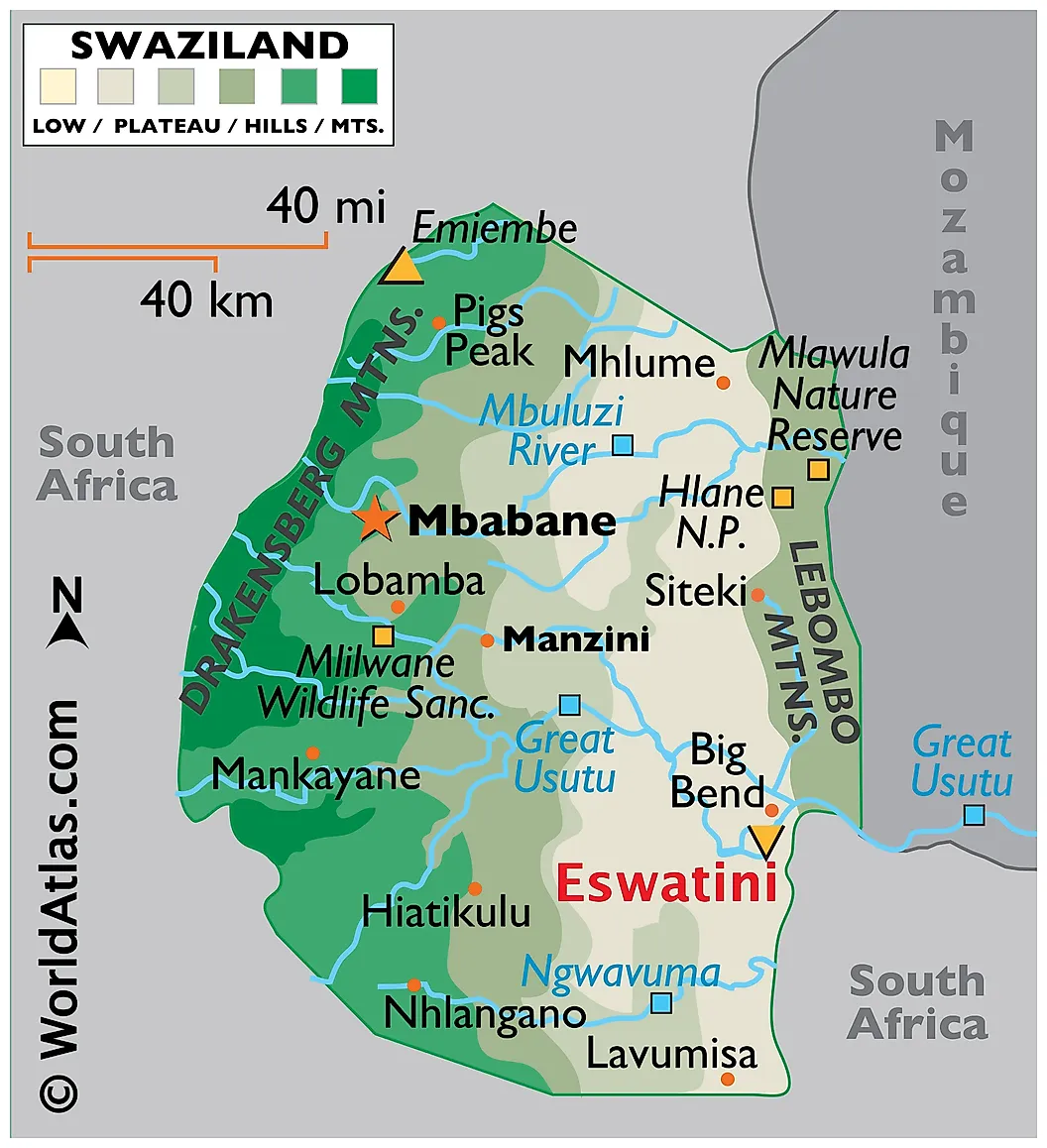
Eswatini, formerly known as Swaziland, is a landlocked country situated in Southern Africa. It shares borders with Mozambique to the northeast and is otherwise encircled by South Africa. Despite its relatively modest size, Eswatini’s diverse topography and climate zones contribute to a rich tapestry of natural landscapes.
Location and Size
Eswatini is positioned between latitudes 25° and 28°S and longitudes 31° and 32°E. The nation extends approximately 175 kilometers from north to south and about 130 kilometers from west to east at its broadest points. Covering an area of 17,364 square kilometers, it is one of Africa’s smallest countries, slightly smaller than the U.S. state of New Jersey.Topographical Regions
Eswatini’s landscape is categorized into four distinct regions running longitudinally from west to east: the Highveld, Middleveld, Lowveld, and Lubombo Plateau.
Highveld: Occupying the western part of the country, the Highveld is characterized by mountainous terrain with elevations ranging from 1,200 to 1,800 meters. This region experiences a temperate climate with significant rainfall, supporting lush forests and grasslands. The country’s highest peak, Emlembe, stands at 1,862 meters in this area.
Middleveld: Situated east of the Highveld, the Middleveld consists of undulating hills and valleys at elevations between 400 and 800 meters. It enjoys a moderate climate and is the most densely populated region, owing to its fertile soils suitable for agriculture. Major urban centers, including the administrative capital Mbabane and the traditional capital Lobamba, are located here.
Lowveld: Further east, the Lowveld lies at elevations between 150 and 300 meters. This area experiences a hotter, semi-arid climate with lower rainfall, making it suitable for sugarcane plantations, a significant component of Eswatini’s economy. The vegetation here consists mainly of savannah grasslands and thorny bushveld.
Lubombo Plateau: The easternmost region is the Lubombo Plateau, a narrow mountain range rising to about 600 meters along the border with Mozambique. This plateau is characterized by steep escarpments and fertile valleys, supporting both agriculture and conservation areas. The Lubombo region is known for its unique flora and fauna, with conservation efforts aimed at preserving its biodiversity.
Climate
Eswatini’s climate varies from tropical to near temperate, influenced by its diverse topography. The Highveld experiences a temperate climate with high rainfall, while the Lowveld has a hotter, semi-arid climate with lower rainfall. The Middleveld enjoys a moderate climate, and the Lubombo Plateau has a climate similar to the Lowveld but with slightly cooler temperatures due to its elevation.
Hydrology
Several rivers traverse Eswatini, playing a crucial role in agriculture, hydroelectric power, and supporting biodiversity. Major rivers include the Great Usutu River, which is the country’s longest river, and the Komati River. These rivers are vital for irrigation and are integral to the country’s agricultural productivity.
Natural Resources and Land Use
Eswatini’s natural resources include asbestos, coal, clay, cassiterite, hydropower, forests, and small gold and diamond deposits. Approximately 11% of the land is arable, with agriculture being a significant part of the economy. The country also has conservation areas and game reserves, which are important for tourism and biodiversity preservation.
Environmental Challenges
Like many nations, Eswatini faces environmental challenges, including soil erosion, deforestation, and overgrazing. Conservation efforts are ongoing to address these issues and to protect the country’s rich biodiversity.
Eswatini is unique in Africa as it is the continent’s last absolute monarchy. Since 1986, King Mswati III has held supreme executive, legislative, and judicial powers, effectively placing him above the constitution. The king’s authority extends over all branches of the national government, and he also influences local governance through traditional chiefs.
Constitution and Governance
In 2005, Eswatini adopted a new constitution, which the government describes as establishing a “monarchical democracy.” This system combines elements of traditional monarchy with democratic principles. However, in practice, the king retains overarching control over governance. The constitution provides for a dual system of governance, blending parliamentary structures with traditional Swazi law and customs.
Executive Branch
The executive authority in Eswatini is vested in the king, who appoints the prime minister and the cabinet. The prime minister serves as the head of government and is responsible for overseeing the administration of government policies. However, the king holds the ultimate decision-making power, and the prime minister’s authority is limited by the monarch’s overarching control.
Legislative Branch
Eswatini’s legislative branch is bicameral, consisting of the Senate and the House of Assembly. Members of the House of Assembly are elected through the Tinkhundla system, a unique electoral framework that emphasizes individual merit and devolution of power to local constituencies. Political parties are banned, and candidates contest as independents. The Senate comprises members appointed by the king and the House of Assembly. While the legislature exists, its powers are limited, and the king retains the authority to overrule legislative decisions.
Judicial Branch
The judiciary in Eswatini operates under a dual system, incorporating both Western-style courts and traditional Swazi courts that apply customary law. Judges are appointed by the king and serve until the mandatory retirement age of 75. While the judiciary is intended to function independently, the king’s influence over appointments and the overarching political structure can impact judicial impartiality.
Human Rights and Political Climate
Eswatini’s political environment has been characterized by restrictions on political dissent and limited freedoms. The banning of political parties and the king’s extensive powers have led to criticisms from international human rights organizations. Freedom House’s 2024 report notes that political dissent and civic activism are subject to harsh punishment under sedition and other laws. In recent years, there have been instances of violence against pro-democracy activists. For example, in 2023, prominent human rights lawyer and opposition activist Thulani Maseko was assassinated, highlighting the risks faced by those opposing the monarchy.
Recent Developments
In September 2023, Eswatini held legislative elections to select members of its House of Assembly. Due to the ban on political parties, all candidates contested as independents. Media reports indicate that most of the elected parliamentarians are considered loyal to the king, reflecting the limited scope for political opposition within the existing system. Additionally, the country has faced challenges related to human rights abuses and the suppression of pro-democracy movements. The government’s response to protests has been marked by violence, with security forces accused of using excessive force against demonstrators.
International Relations
Eswatini maintains diplomatic relations with various countries and is a member of international organizations such as the United Nations and the African Union. The country’s political system and human rights record have been subjects of international scrutiny. For instance, the United States Department of State has highlighted concerns regarding the lack of political freedoms and the centralization of power in the monarchy.
The services sector is the largest contributor to Eswatini’s Gross Domestic Product (GDP), accounting for slightly more than half of the economy. Industry, particularly manufacturing, comprises another third, while agriculture, forestry, and mining collectively contribute about 13% to the GDP.
Agriculture
Agriculture plays a vital role in Eswatini’s economy, employing approximately 70% of the population. The sector is characterized by a dual system: Title Deed Lands (TDL) and Swazi Nation Land (SNL). TDL, which includes high-value crops such as sugar, forestry, and citrus, benefits from substantial investment and irrigation, leading to high productivity. In contrast, SNL, where the majority of the population engages in subsistence farming, suffers from low productivity and limited investment.
Manufacturing and Industry
The manufacturing sector is a significant component of Eswatini’s economy, contributing around 37% to the GDP. Key industries include textiles, sugar processing, and soft drink concentrates. The country has historically benefited from trade preferences for apparel exports under the African Growth and Opportunity Act (AGOA) to the United States and for sugar exports to the European Union. However, the phasing out of these preferences poses challenges to the competitiveness of these industries.
Trade Relations
Eswatini’s economy is closely linked to that of South Africa, which accounts for about 65% of its exports and 75% of its imports. This close relationship is facilitated by Eswatini’s membership in the Southern African Customs Union (SACU) and the Common Monetary Area (CMA), which allows for the free movement of goods and capital between member countries. The country’s other key trading partners include the United States and the European Union, though the reliance on trade preferences has made Eswatini vulnerable to changes in international trade policies
.Economic Performance
Eswatini’s economic growth has been modest in recent years. The economy grew from 0.5% in 2022 to an estimated 4.8% in 2023, driven by a stronger performance in the services sector. Aggregate demand is largely driven by consumption, which constitutes 84% of GDP, and investment, at 13% of GDP. Despite this growth, the country faces challenges such as high unemployment rates, particularly among the youth, and widespread poverty. In 2006, the unemployment rate was estimated at 40%, and 69% of the population was living below the poverty line.
Fiscal Policy and Public Finances
Eswatini’s public finances have experienced fluctuations over the past decades. The country has faced challenges related to declining revenues and increased spending, leading to significant budget deficits. A substantial portion of government revenue comes from SACU receipts, which account for over 50% of total government revenues. However, these revenues are subject to variability, making fiscal planning challenging. The wage bill constitutes over 15% of GDP and 55% of total public spending, among the highest levels on the African continent.
Monetary Policy and Inflation
Eswatini’s currency, the lilangeni (plural: emalangeni), is pegged at par with the South African rand, facilitating stable exchange rates and trade relations with its dominant neighbor. In 2023, inflation rose to 5%, prompting monetary authorities to adjust the discount rate from 3.75% in March 2022 to 7.75% in July 2023, before settling at 7.5% since August 2023.
Investment Climate
Eswatini’s investment climate presents both opportunities and challenges. The country’s firms are among the most productive in Sub-Saharan Africa, although they lag behind those in the most productive middle-income countries in other regions. Challenges such as inadequate governance arrangements and infrastructure hinder the investment climate. The country’s national development strategy, which expired in 2022, prioritized increases in infrastructure, agricultural production, and economic diversification, aiming to reduce poverty and government spending.
Outlook and Challenges
Looking ahead, Eswatini’s economic growth is expected to pick up moderately in 2024-2025, reflecting improved growth prospects in South Africa, its key export market. However, challenges such as the impact of El Niño on the agricultural sector and the monarchy’s control over the state may hinder growth. Policy priorities are likely to focus on preserving the influence of the monarchy, which could affect private-sector development.
Eswatini, formerly known as Swaziland, is a landlocked country in Southern Africa with a population of approximately 1.2 million people as of 2023. The nation is characterised by a rich cultural heritage, a predominantly youthful demographic, and a high prevalence of HIV/AIDS
Population Size and Growth
As of 2023, Eswatini’s population is estimated at 1,230,506 individuals. The annual population growth rate is relatively modest, at approximately 0.785% in 2022. This growth rate reflects a balance between birth and death rates, influenced by factors such as fertility rates, health conditions, and life expectancy.
Age Structure
Eswatini’s population is predominantly young, with 34% under the age of 15 as of 2024. This youthful demographic is indicative of high fertility rates in previous decades. The age dependency ratio, which compares the non-working-age population to the working-age population, stands at 63.12% as of 2022, suggesting a significant proportion of dependents relative to the workforce.
Ethnic Composition
The majority of Eswatini’s population is ethnically Swazi, comprising over 90% of the populace. There are also small communities of Zulu, Tsonga, and White Africans, predominantly of British and Afrikaner descent. This homogeneity has fostered a strong sense of national identity and cultural cohesion
Languages
SiSwati and English are the official languages of Eswatini. SiSwati, a Bantu language of the Nguni group, is spoken by the majority and is integral to cultural and traditional practices. English is widely used in government, business, and education, serving as the medium of instruction in schools. Additionally, languages such as Zulu and Tsonga are spoken by minority communities within the country.
Religious Affiliation
Christianity is the predominant religion in Eswatini, adhered to by approximately 83% of the population. Among Christians, Anglican, Protestant, and indigenous African churches, including the African Zionist Church, constitute the majority, followed by Roman Catholicism. Traditional beliefs are also practiced, sometimes in conjunction with Christianity. Other religions, such as Islam, the Baháʼí Faith, and Hinduism, are present but constitute a small fraction of the population.
Urbanisation
Eswatini’s population is predominantly rural, with less than a quarter residing in urban areas. The largest cities include Mbabane, the capital, and Manzini, the commercial hub. Urbanisation is gradually increasing, influenced by factors such as employment opportunities, education, and access to services.
Health Indicators
Eswatini faces significant health challenges, notably the highest prevalence of HIV among people aged 15 to 49 globally, at 27.1% as of 2019. This has impacted life expectancy, which was approximately 56.4 years in 2022. The infant mortality rate was 41.5 per 1,000 live births in 2021, reflecting ongoing public health challenges.
Education
Eswatini has made strides in improving educational access and literacy rates. Primary education is compulsory and free, leading to high enrolment rates. However, challenges remain in secondary and tertiary education, including affordability and resource constraints. The government continues to invest in educational infrastructure and programmes to enhance the quality and reach of education.
Economic Participation
The economy of Eswatini is diverse, with sectors such as agriculture, manufacturing, and services contributing to the GDP. The labour force participation rate is influenced by factors such as education, health, and urbanisation. Unemployment, particularly among the youth, remains a concern, prompting initiatives aimed at job creation and skills development.
Migration and Diaspora
Eswatini has experienced both emigration and immigration. Some citizens migrate to neighbouring countries, such as South Africa, seeking employment opportunities, especially in sectors like mining. Conversely, Eswatini hosts refugees and immigrants, contributing to its cultural diversity.
Eswatini, formerly known as Swaziland, is a landlocked nation in Southern Africa renowned for its rich cultural heritage that reflects the traditions and values of the Swazi people. The nation’s culture is deeply rooted in communal values, traditional ceremonies, and artistic expressions that have been preserved and celebrated over centuries.
Traditional Ceremonies
One of the most significant cultural events in Eswatini is the Incwala Ceremony, often referred to as the “Kingship Ceremony.” Held annually around December or January, this sacred event marks the beginning of the Swazi traditional new year and celebrates the first fruits of the harvest. The ceremony involves various rituals, including young men journeying to collect branches of the lusekwane shrub, which are integral to the festivities. The climax occurs on the fourth day when the King, adorned in full ceremonial attire, joins his warriors in traditional dance and partakes in the season’s first fruits. This ceremony not only reinforces the nation’s unity but also reaffirms the King’s role as the spiritual and political leader.
Another prominent event is the Umhlanga, or Reed Dance, held annually between late August and early September. This vibrant ceremony celebrates the purity and chastity of young Swazi maidens. Thousands of unmarried and childless girls gather reeds, which are then presented to the Queen Mother. Dressed in traditional attire adorned with beads and sashes, the maidens perform dances before the King and Queen Mother, symbolizing their transition into womanhood and their commitment to community values.
The Marula Festival, celebrated between February and May, is another cultural highlight. This festival pays tribute to the marula fruit, which holds significant cultural and economic importance in Eswatini. The festivities, led by the King and Queen Mother, involve song, dance, and the brewing of traditional marula beer. The marula tree is revered not only for its fruit but also for its medicinal properties and its role in promoting fertility.
Social Structure and Homesteads
The Swazi social structure is traditionally organized around the homestead, known as umuti. A typical homestead consists of multiple huts, each serving specific purposes such as sleeping, cooking, and storage. Central to the homestead is the cattle kraal (sibaya), a circular enclosure made of logs, symbolizing wealth and prestige. Cattle play a crucial role in Swazi culture, serving not only as a measure of wealth but also being integral to various rituals and ceremonies.
Polygamy is traditionally practiced, with each wife having her own hut within the homestead. The head of the homestead, usually the eldest male, holds authority and is responsible for making decisions that affect the family. This patriarchal structure ensures the preservation of customs and the transmission of cultural values across generations.
Arts and Crafts
Eswatini boasts a vibrant arts and crafts scene that reflects the nation’s cultural heritage. Traditional crafts include beadwork, pottery, and weaving. Beadwork is particularly significant, with items like the ligcebesha (a colorful necklace) and the indlamu (a traditional skirt) being prominent examples. Pottery, such as clay pots known as tindziwo, is used for various purposes, including cooking and storage. Weaving of grass mats (emacansi) and baskets showcases the intricate skills passed down through generations.
The handcraft industry is a vital part of Eswatini’s economy, providing employment to many, especially women. Products range from housewares to artistic decorations, often reflecting traditional patterns and techniques. This industry not only preserves cultural practices but also promotes sustainable economic development.
Music and Dance
Music and dance are integral components of Swazi culture, serving as expressions of identity and communal values. Traditional dances, such as the Sibhaca, are vigorous performances involving teams of men stomping their feet in unison, accompanied by rhythmic music and chants. Dancers wear colorful quilts and decorate their legs with mohair implements, showcasing the nation’s rich textile traditions. These performances are not only entertainment but also a means of storytelling and preserving history.
In conclusion, Eswatini’s culture is a tapestry woven from its ceremonies, social structures, arts, and communal activities. The nation’s commitment to preserving and celebrating its heritage ensures that the Swazi identity remains vibrant and resilient in the face of modernization.
Eswatini, formerly known as Swaziland, is a landlocked nation in Southern Africa that has been an active member of the Commonwealth of Nations since its independence from Britain in 1968.
Over the decades, Eswatini has engaged in various initiatives and programs facilitated by the Commonwealth, aiming to bolster its socio-economic development, governance structures, and human rights mechanisms.
Governance and Institutional Support
The Commonwealth has played a pivotal role in enhancing Eswatini’s governance and institutional frameworks. One notable area of collaboration has been the strengthening of the judiciary. Since 2008, the Commonwealth has provided judges to assist Eswatini’s High Court, resulting in the clearance of over 5,000 backlog cases. This intervention has been instrumental in ensuring timely justice and reinforcing the rule of law in the country.
In addition to judicial support, the Commonwealth has extended technical assistance to Eswatini’s Directorate on Corruption and Economic Offences. This collaboration focuses on enhancing the country’s capacity to combat corruption through prevention, investigation, prosecution, and public education initiatives. Such efforts are crucial in promoting transparency and accountability within public institutions.
Human Rights Initiatives
The promotion and protection of human rights have been central to the partnership between Eswatini and the Commonwealth. The Commonwealth’s Human Rights Unit has been actively involved in capacity-building initiatives for Eswatini’s Commission on Human Rights and Public Administration (ECHRPA). In a notable instance, the Commonwealth facilitated a working session where officials from the Kenya National Commission on Human Rights shared their extensive experience with their Eswatini counterparts. This exchange aimed to bolster the ECHRPA’s institutional capacity, case management, and stakeholder engagement, thereby strengthening the country’s human rights framework.
Furthermore, the Commonwealth has supported Eswatini in establishing a National Mechanism for Implementation, Reporting, and Follow-up (NMIRF). This framework is designed to coordinate the country’s reporting and implementation obligations concerning United Nations human rights mechanisms. The establishment of the NMIRF underscores Eswatini’s commitment to upholding its international human rights obligations and enhancing its engagement with global human rights bodies.
Economic and Social Development
Eswatini’s economic and social development has also benefited from its relationship with the Commonwealth. The Commonwealth Fund for Technical Assistance (CFTC) has been instrumental in various sectors, including:
Public Service Governance: The CFTC has promoted e-governance initiatives, aiming to improve efficiency and transparency within Eswatini’s public service.
Debt Management: Through the provision of advisers and specialized software, the Commonwealth has assisted Eswatini in achieving sustainable debt management, contributing to the country’s financial stability.
Entrepreneurship Development: Support has been extended to the University of Eswatini’s Entrepreneurship and Business Development Centre, focusing on enhancing the competitiveness of micro, small, and medium-sized enterprises.
Natural Resources Management: The Commonwealth has provided guidance on reforming Eswatini’s mining and petroleum sectors, including the development of relevant laws and policies to ensure sustainable resource utilization.
Democratic Processes and Political Stability
The Commonwealth has been an advocate for democratic processes and political stability in Eswatini. In response to episodes of civil unrest and calls for democratic reforms, the Commonwealth has urged calm and restraint, emphasizing the importance of dialogue and adherence to the rule of law. For instance, during periods of political tension, the Commonwealth called for all political and civic leaders to promote unity and utilize peaceful channels to address grievances, reaffirming its commitment to working with Eswatini towards sustainable peace and democracy.
Capacity Building and Knowledge Exchange
Capacity building and knowledge exchange have been integral components of Eswatini’s engagement with the Commonwealth. Over the past five years, approximately 246 public servants from Eswatini have received training through Commonwealth programs. These initiatives have covered a broad spectrum, from human resources planning and leadership development to enhancing the tourism industry’s capacity. Such programs aim to equip Eswatini’s public sector with the necessary skills and knowledge to drive national development effectively.
