
Commonwealth Portal is grateful to the following individual and business supporter, who has enabled us to maintain and expand the contents regarding St Vincent and the Grenadines.
The name “St Vincent” is believed to have been bestowed by the Spanish explorer Juan de la Cosa, who named the island after St Vincent of Saragossa, a 4th-century Christian martyr. The “Grenadines” derives from the word “Grenada,” the nearby island nation to the north, although the two are not politically related. The Grenadines are an archipelago that stretches southward from St Vincent and includes islands like Bequia, Mustique, and Canouan, each with distinct cultural and historical identities.
Historically, the islands have been referred to collectively as the “Windward Islands” because of their position relative to trade winds that swept through the Caribbean. The term “Saint Vincent and the Grenadines” is a direct reflection of the country’s geographic and political structure, acknowledging both the main island and the smaller archipelago.
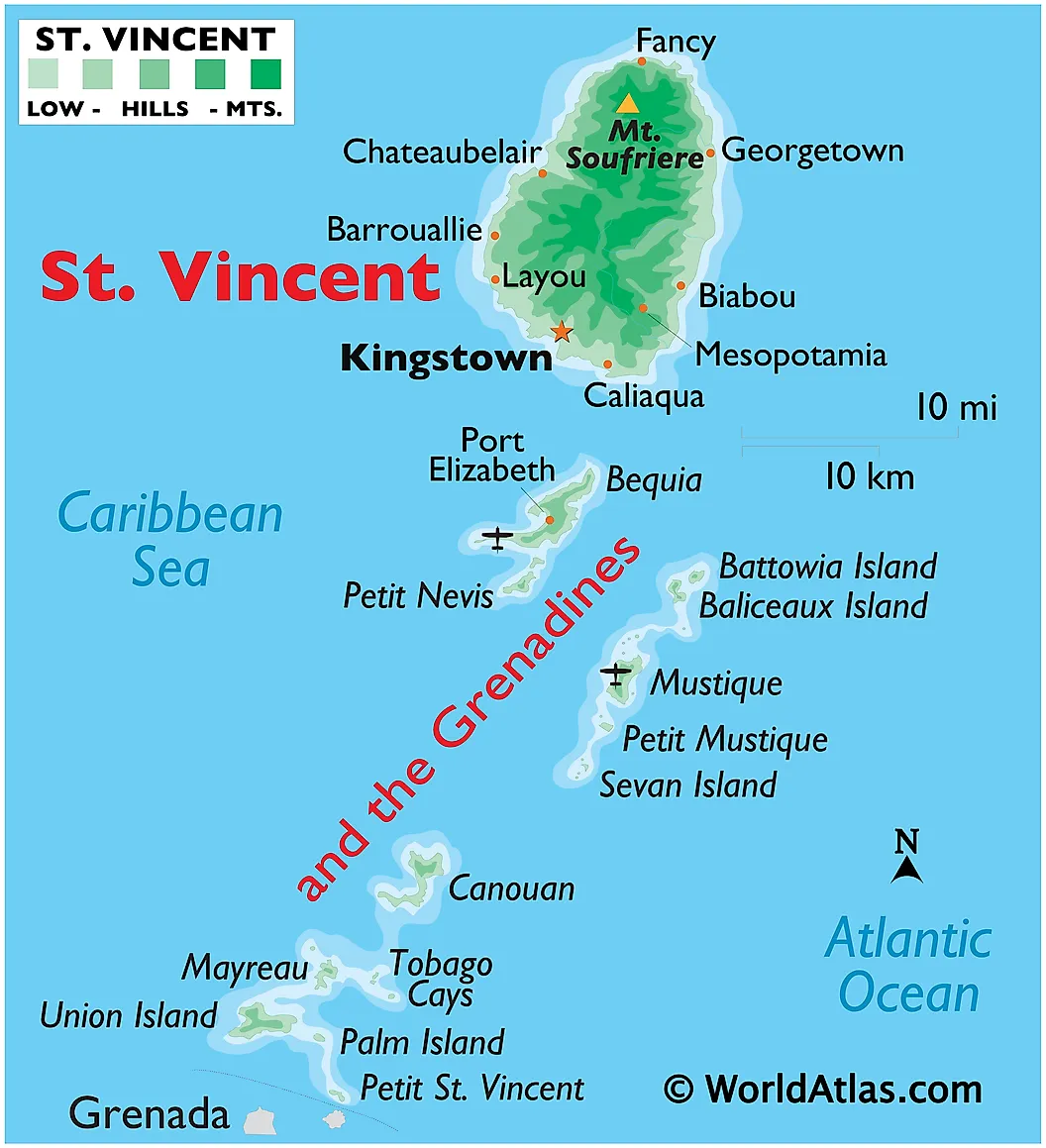
St Vincent and the Grenadines is an island nation situated in the Caribbean, comprising the main island of St Vincent and an archipelago of smaller islands. St Vincent, the largest and most populous island, is volcanic in origin and features a mountainous terrain with a rugged coastline. The country is home to lush rainforests, tropical vegetation, and the famous La Soufrière volcano, which erupted most recently in 2021, causing widespread damage but no fatalities. The island’s highest point is the summit of La Soufrière, which stands at 1,234 metres (4,049 feet).
The Grenadines, a group of smaller islands that stretch south from St Vincent, are known for their crystal-clear waters, coral reefs, and secluded beaches. These islands, which include Bequia, Mustique, and Canouan, are popular with tourists and boast a wide variety of marine life. The country’s coastal waters are also an important habitat for sea turtles and other marine species.
The tropical climate of St Vincent and the Grenadines is characterised by a wet season from June to November and a dry season from December to May. The islands’ natural environment provides a range of ecological and economic opportunities, particularly in agriculture and tourism.
St Vincent and the Grenadines is a constitutional monarchy with a parliamentary democracy. The country’s political structure is influenced by its history as a British colony. The British monarch, as head of state, is represented by a Governor-General, while the Prime Minister is the head of government.
The nation’s political system consists of a bicameral parliament, which includes the elected House of Assembly and the appointed Senate. The Prime Minister is the leader of the majority party in the House of Assembly, and the current Prime Minister, as of 2025, is Ralph Gonsalves, who has held office since 2001.
St Vincent and the Grenadines is a member of the Commonwealth of Nations, a group of nations with historical ties to the British Empire. While the monarchy plays a symbolic role, the nation operates as a parliamentary democracy where power rests in the hands of the elected representatives of the people.
The political climate in SVG is marked by the dominance of the Unity Labour Party (ULP), which has enjoyed a prolonged period of governance since the early 2000s. Political life in SVG is also influenced by the opposition New Democratic Party (NDP), which has been active in challenging government policies.
The economy of St Vincent and the Grenadines is primarily based on agriculture, tourism, and services. Historically, the country’s economy was centred around the production of sugar, bananas, and other agricultural products. Banana exports were particularly important in the late 20th century, though this industry has declined in recent years due to global competition and changing market conditions.
Agriculture still plays an important role in the economy, with key crops including bananas, coconuts, and cocoa. The island’s fertile soil and tropical climate are conducive to the cultivation of a variety of fruits, vegetables, and spices. The government has also encouraged diversification into sectors like fishing and small-scale manufacturing.
Tourism is a critical industry for St Vincent and the Grenadines, with visitors drawn to the country’s natural beauty, beaches, and sailing opportunities. The Grenadines, with their pristine waters and luxury resorts, are particularly popular with affluent tourists. The country is also an increasingly popular destination for yacht charters, and the development of airport infrastructure has made it more accessible to international visitors.
Despite its reliance on agriculture and tourism, St Vincent and the Grenadines faces economic challenges such as high levels of public debt, vulnerability to natural disasters, and limited domestic market size. The government has been working to develop new economic opportunities through infrastructure projects and international trade.
St Vincent and the Grenadines has a population of approximately 110,000 people, with the majority residing on the main island of St Vincent. The population is ethnically diverse, with a mixture of Afro-descendants, Carib (indigenous people), and European ancestry. The Afro-Vincentian population, which is the largest group, traces its origins to enslaved Africans brought to the island during the colonial era.
The language spoken in St Vincent and the Grenadines is English, though a variety of local creole is also widely spoken, reflecting the island’s cultural heritage. The nation has a relatively young population, though like many Caribbean nations, it faces challenges related to youth unemployment and migration, as many young people seek opportunities abroad.
Christianity is the dominant religion, with most of the population identifying as Protestant, followed by Roman Catholicism. Religion plays an important role in social life, with many public holidays and festivals tied to Christian traditions.
The culture of St Vincent and the Grenadines is a vibrant mix of African, European, and indigenous influences. The country’s cultural identity is shaped by its historical experience of colonialism, slavery, and post-colonial independence. Music plays a key role in the cultural life of St Vincent and the Grenadines, with calypso, soca, and reggae being popular genres. The annual carnival, known as Vincy Mas, is one of the most significant cultural events in the country, drawing visitors and celebrating local music, dance, and costumes.
The island’s culinary traditions reflect its diverse heritage, with dishes such as roasted breadfruit, callaloo soup, and saltfish being staples of the local diet. Seafood is also prominent, particularly in coastal communities.
St Vincent and the Grenadines has a rich artistic tradition, particularly in the fields of painting, sculpture, and literature. The nation’s vibrant visual arts scene is marked by the works of local artists who draw inspiration from the island’s natural beauty and complex cultural history.
St Vincent and the Grenadines is a member of the Commonwealth of Nations, a political association of countries, most of which were former territories of the British Empire. While the country retains the British monarch as its ceremonial head of state, it operates as a sovereign nation with its own political and legal systems.
As a member of the Commonwealth, St Vincent and the Grenadines engages in various cultural, educational, and economic activities, contributing to the broader network of Commonwealth countries. The country actively participates in initiatives that promote regional cooperation, sustainable development, and democratic governance. St Vincent and the Grenadines is also part of the Caribbean Community (CARICOM), an organisation that works to enhance regional integration and cooperation.
