
Commonwealth Portal is grateful to the following individual and business supporter, who has enabled us to maintain and expand the contents regarding Pakistan.
The name “Pakistan” was coined in 1933 by Choudhary Rahmat Ali, a Cambridge-educated Muslim nationalist. The term is derived from several sources: “P” for Punjab, “A” for Afghania (the North-West Frontier Province), “K” for Kashmir, “S” for Sindh, and “tan” meaning land in Persian. It can be roughly translated as “the land of the pure” in Urdu and Persian, signifying a homeland for Muslims of the Indian subcontinent.
The terminology of “Pakistani” refers to citizens of Pakistan, regardless of ethnicity or region. However, ethnic and regional identities such as Punjabi, Pashtun, Sindhi, and Baloch continue to play a significant role in the national consciousness. Pakistan is a diverse nation with multiple linguistic, cultural, and religious groups.
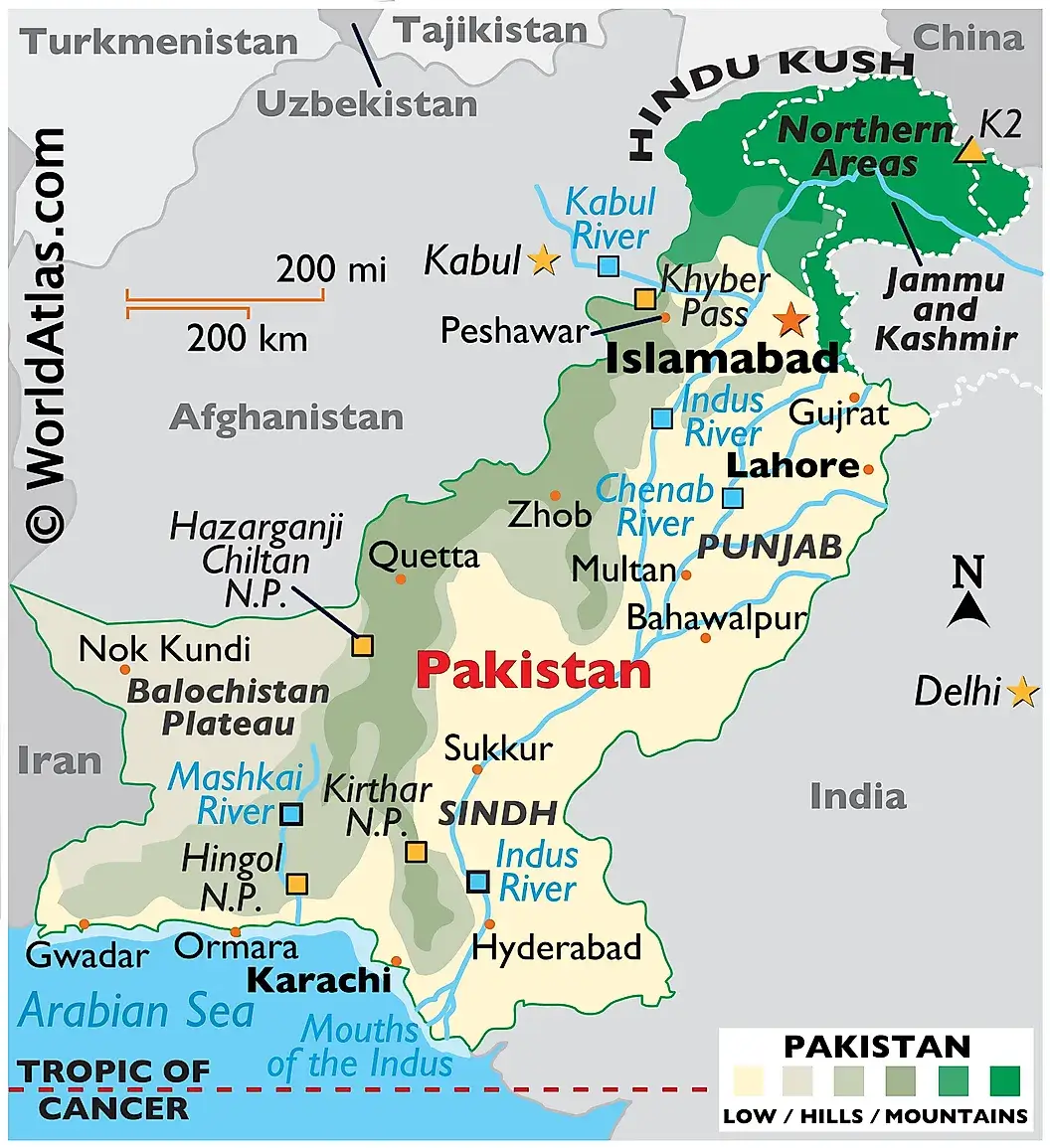
Pakistan covers an area of 881,913 square kilometres, making it the 33rd largest country in the world. Geographically, it is a land of contrast, with landscapes ranging from mountains and deserts to lush plains. The northern region of Pakistan is dominated by the Himalayan and Hindu Kush mountain ranges, which include some of the highest peaks in the world, such as K2, the second-highest mountain after Mount Everest.
To the south, Pakistan is bordered by the Arabian Sea, with the city of Karachi serving as its major port. In the central and eastern regions, the vast Indus River Plain supports a large portion of the population and is one of the most fertile agricultural regions in the world. The southwestern Balochistan region is arid and mountainous, while the northwestern frontier is home to rugged terrain, including the Khyber Pass, a historically significant trade route.
Pakistan experiences a wide range of climatic conditions, from the arid conditions in the southwest to the humid and tropical climate in the southeast. The northern regions, including Gilgit-Baltistan, are known for their cold winters and are popular destinations for mountaineers and tourists.
Pakistan operates as a federal parliamentary republic, where the president is the ceremonial head of state and the prime minister is the head of government. The political system is characterised by a multi-party structure, and elections are held every five years to elect members of the National Assembly, which is the lower house of parliament. The upper house, the Senate, represents the provinces.
The country has experienced frequent periods of military rule since its independence. Notably, General Ayub Khan, General Zia-ul-Haq, and General Pervez Musharraf have all taken power through coups and governed for extended periods. These periods of military rule were marked by political suppression, constitutional changes, and significant impacts on Pakistan’s democratic institutions. Pakistan returned to civilian rule in 2008 after the resignation of President Pervez Musharraf.
The country’s politics remain highly fragmented, with power often divided between the two major political parties, the Pakistan Peoples Party (PPP) and the Pakistan Muslim League (Nawaz) (PML-N). In recent years, the Pakistan Tehreek-e-Insaf (PTI), led by former cricketer Imran Khan, has emerged as a key political force. Ethnic and regional divisions also influence political dynamics, with provincial parties in Balochistan, Sindh, and Khyber Pakhtunkhwa playing crucial roles in governance.
Pakistan’s economy is diverse, with key sectors including agriculture, manufacturing, and services. The country is one of the world’s largest producers of textiles, which account for a significant portion of its exports. Other major industries include food processing, chemicals, cement, and steel production. However, Pakistan’s economy faces challenges such as poverty, unemployment, inflation, and a large informal sector.
Agriculture remains an important part of Pakistan’s economy, employing a large proportion of the population. The Indus River provides irrigation to much of the country’s farmland, and crops such as wheat, rice, cotton, and sugarcane are essential to its agricultural output. However, Pakistan faces issues related to water scarcity, soil degradation, and climate change, which threaten agricultural productivity.
Pakistan’s services sector has grown in importance in recent years, particularly in areas such as telecommunications, banking, and information technology. Despite having significant potential for economic growth, Pakistan faces economic instability, largely due to political challenges, corruption, and regional security concerns.
Pakistan is the fifth-most populous country in the world, with a population of approximately 240 million people. The population is ethnically diverse, with major groups including Punjabis, Pashtuns, Sindhis, and Baloch, as well as smaller communities of Mohajirs (immigrants from India after partition) and other ethnicities.
Urdu, the national language, is spoken by the majority of the population, although regional languages such as Punjabi, Pashto, Sindhi, and Balochi are widely spoken. English, a legacy of British colonial rule, is also commonly used in business, government, and higher education.
Islam is the dominant religion in Pakistan, with around 95% of the population being Muslim. The country is an Islamic republic, and its laws are largely based on Islamic principles. While Sunni Muslims form the majority, there are significant Shia Muslim and Ahmadiyya minorities. Religious minorities, such as Christians, Hindus, and Sikhs, make up a small portion of the population, and their rights are often a topic of debate.
Pakistan has a rich and diverse cultural heritage, shaped by its history and various ethnic groups. The country is known for its literature, music, art, and cuisine, all of which reflect the influences of Islamic, Persian, Central Asian, and South Asian traditions.
Pakistani literature has produced many renowned poets and writers, including Allama Iqbal, Faiz Ahmed Faiz, and Bapsi Sidhwa. Music in Pakistan is equally diverse, with classical, folk, qawwali, and contemporary genres flourishing. The country has produced international music stars, such as Nusrat Fateh Ali Khan and Rahat Fateh Ali Khan, as well as popular contemporary artists like Atif Aslam and Ali Zafar.
Pakistani cuisine is characterised by its use of spices and herbs, with dishes such as biryani, haleem, kebabs, and various types of bread like naan and roti being staples. Regional variations abound, with Punjabi, Sindhi, and Pashtun cuisines offering distinct flavours and ingredients.
Pakistan is a member of the Commonwealth of Nations, a political association of 56 member states, most of which were former territories of the British Empire. Pakistan joined the Commonwealth in 1947, shortly after gaining independence from Britain, and has remained a member ever since. However, its relationship with the Commonwealth has been complex, especially after periods of military rule, which led to temporary suspensions from the organisation.
Despite these challenges, Pakistan has maintained a strong presence in the Commonwealth, contributing to discussions on global governance, trade, and development. Pakistan is also involved in various Commonwealth programmes that focus on education, human rights, and economic development.
