
The name “Nauru” is derived from the Nauruan word Anáoero, which translates to “I go to the beach” or “the beach”. This is an apt description, considering that the island is surrounded by coral reefs and pristine beaches.
The people of Nauru are referred to as “Nauruans”. Nauru is one of the few countries where the indigenous language, Nauruan, is spoken by the majority of the population, though English is also an official language. Nauru is officially designated as the “Republic of Nauru”, emphasising its status as a sovereign republic.
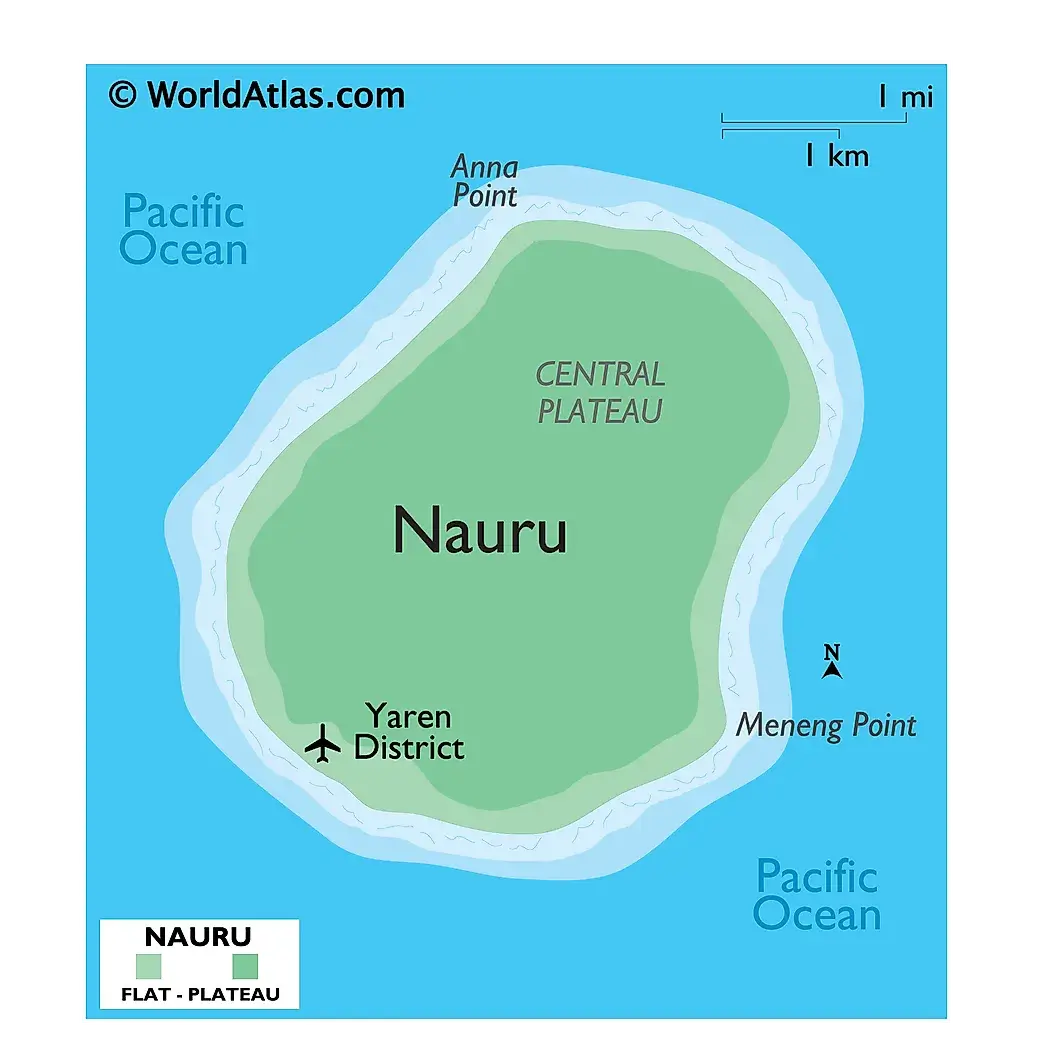
Nauru is a small, isolated island situated in the Pacific Ocean, about 1,300 kilometres north-east of Australia. The island is circular, with a diameter of approximately 21 kilometres. It is surrounded by coral reefs and has a narrow coastal strip. Nauru’s geography is largely defined by the phosphate-rich central plateau, which was the site of the island’s extensive phosphate mining operations.
The island’s terrain is mostly arid, with a small amount of tropical vegetation. The central plateau, which once held dense forests and fertile soil, is now almost completely denuded, as phosphate mining has removed the majority of the island’s topsoil. The remainder of the island is divided into small pockets of agriculture and settlement, as well as a narrow belt of coastal mangrove and beach forest.
Nauru’s location near the equator gives it a tropical climate, characterised by high humidity and temperatures throughout the year. The island is vulnerable to natural disasters such as droughts and has been affected by climate change, particularly the rising sea levels that threaten its fragile coastal areas.
Nauru is a republic with a parliamentary system of government. The President, who is both the head of state and head of government, is elected by the members of the Parliament of Nauru. The President serves a term of three years and has significant executive powers, although the government is also subject to a degree of parliamentary oversight. The legislative body, the Parliament of Nauru, consists of 19 members who are elected for a three-year term through a system of proportional representation.
Nauru has a multi-party political system, but the small size of the country and its political environment mean that parties are often fluid, and leadership frequently changes. The country has experienced a history of political instability, with numerous changes in government, often through no-confidence votes in Parliament. This political volatility has posed challenges to the country’s long-term development and governance.
The judiciary of Nauru is independent, and the country has a legal system based on English common law. Nauru is also a member of the Pacific Islands Forum, which is a regional intergovernmental organisation aimed at promoting cooperation and economic integration across the Pacific.
Nauru’s economy has been historically dependent on phosphate mining, which was the primary source of income for the country for much of the 20th century. The island’s phosphate reserves, formed from seabird guano over thousands of years, were extensively mined and exported, particularly to Australia and other countries. However, by the 1990s, Nauru’s phosphate resources began to dwindle, leaving the country in a precarious economic situation.
In an attempt to diversify, Nauru has sought to develop alternative sources of income. The country has explored opportunities in offshore banking, attracting international financial services and businesses. Nauru has also tried to position itself as a tax haven and has engaged in international aid agreements.
Another significant source of income has been the operation of an Australian immigration detention centre, which has provided Nauru with funding through agreements with the Australian government. However, the reliance on this detention centre has been controversial and has led to criticism of the country’s human rights record.
Agriculture in Nauru is limited due to the island’s small land area and lack of fertile soil. Some food is grown locally, including coconuts, bananas, and vegetables, but the country remains heavily dependent on imported goods.
Nauru has a small population of just over 10,000 people, making it one of the least populous nations in the world. The Nauruan people, who are of Micronesian and Polynesian descent, make up the majority of the population. There are also small communities of expatriates, particularly from Australia, New Zealand, and the Philippines, who have settled in the country for work or business.
The population of Nauru is relatively young, with a significant proportion under the age of 25. The island’s population density is low, given its small land area, and much of the population is concentrated in the capital, Yaren, which is also the political and administrative centre of the country.
The official languages of Nauru are Nauruan and English, with Nauruan being the most commonly spoken language. Nauru is a predominantly Christian country, with the majority of the population identifying as Roman Catholic or Protestant. There are also small communities of other religious groups, including Bahá’ís.
Nauru’s culture is deeply rooted in its indigenous traditions, with a strong emphasis on community and family. The Nauruan people have a rich cultural heritage that includes traditional music, dance, and oral history. Cultural practices are an important part of daily life, and ceremonies and festivals continue to be an integral aspect of Nauruan identity.
Traditional Nauruan music often involves chanting and drumming, and dance plays a key role in social events and celebrations. Nauru’s cultural festivals, which celebrate historical events and local traditions, are important communal occasions. There is also a tradition of storytelling, with elders passing down knowledge and history to younger generations.
In terms of food, Nauruan cuisine includes a variety of seafood, coconuts, and tropical fruits, which are staples in the diet. The country also has a unique way of preparing food, often using traditional cooking methods.
Nauru’s relationship with the Commonwealth of Nations is unique. While it is not a member state of the Commonwealth, it shares a historical connection with the organisation due to its colonial past under Australian administration. Nauru is a member of the Pacific Islands Forum, which includes a number of Commonwealth nations in the Pacific, and the country maintains close ties with Australia, New Zealand, and other Commonwealth states in terms of trade, aid, and regional cooperation.
Nauru’s role within the Commonwealth is mainly as an observer and regional partner, rather than a full member. However, it continues to engage with Commonwealth nations on a range of issues, including economic development, climate change, and regional security.
