
Commonwealth Portal is grateful to the following individual and business supporter, who has enabled us to maintain and expand the contents regarding Ghana.
The name “Ghana” is derived from the ancient Ghana Empire, which was located north of modern-day Ghana, in present-day Mauritania and Western Mali. The word “Ghana” means “warrior king” in the Soninke language, a reference to the rulers of the ancient empire who were known for their military prowess. When British colonial authorities established the colony of the Gold Coast, the name Ghana was retained after independence in 1957 as a way of linking the new nation with its historic past.
The term “Gold Coast” refers to the region’s colonial history when it was known for its gold resources. The official demonym for the people of Ghana is “Ghanaian.”
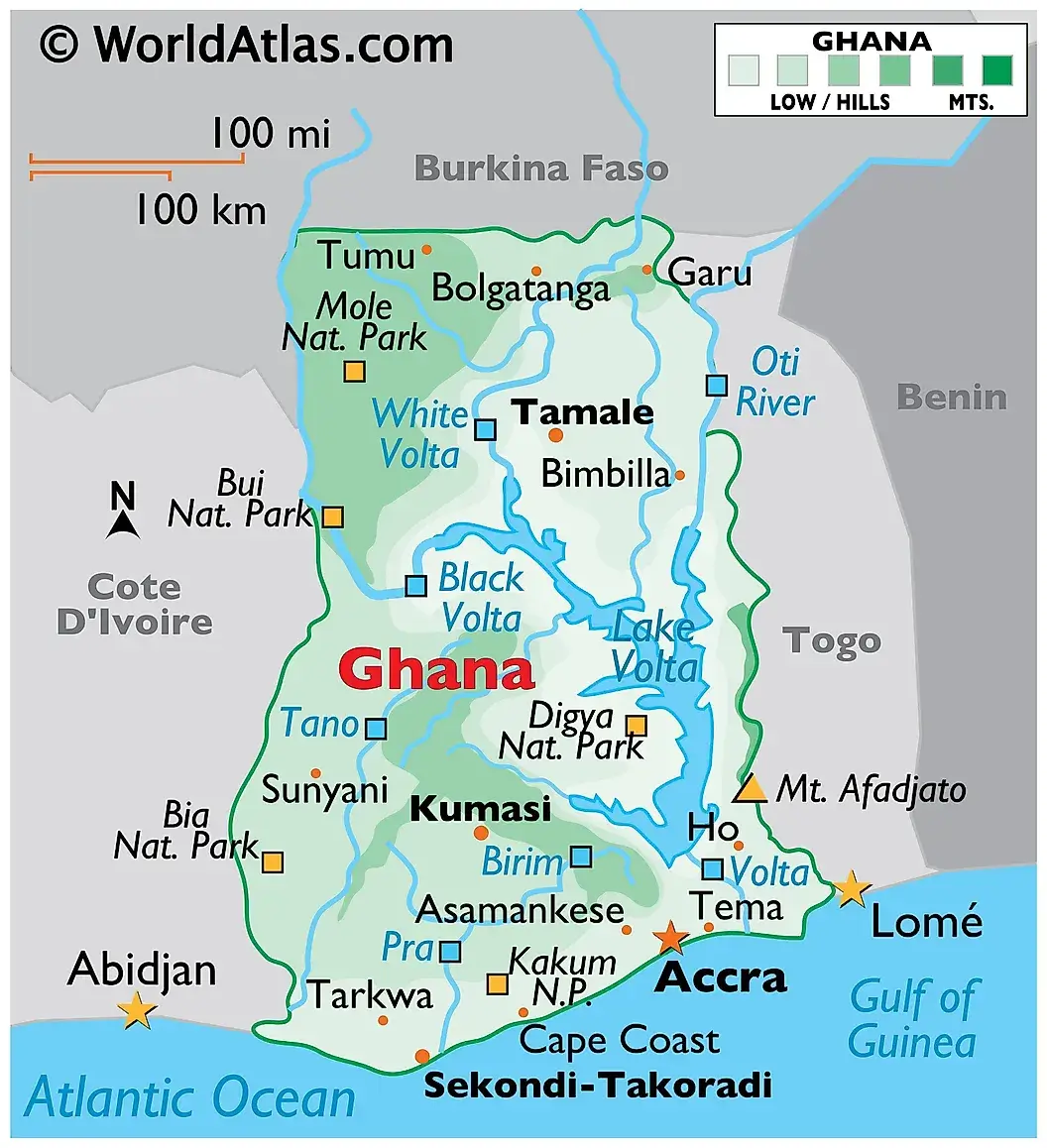
Ghana lies between latitudes 4° and 11°N, and longitudes 3° and 1°W. The country covers an area of approximately 238,533 square kilometres, making it slightly smaller than the UK. The landscape is diverse, ranging from tropical rainforests in the south to savannah regions in the north. Ghana is also home to several rivers, including the Volta River, which is one of the largest in West Africa, and Lake Volta, one of the largest artificial lakes in the world.
The country experiences a tropical climate, with distinct wet and dry seasons. The coastal region is humid and hot, while the northern regions are dry and prone to seasonal droughts. The capital city of Accra is located along the Gulf of Guinea coastline, offering the country strategic access to maritime trade routes.
Ghana is a multi-party constitutional democracy with a political system that includes an executive president, a parliamentary legislature, and an independent judiciary. The president, who is both the head of state and government, is elected every four years. The legislature, the Parliament of Ghana, is unicameral and consists of 275 members.
Since the adoption of its democratic constitution in 1992, Ghana has been a relatively stable democracy in a region often beset by political turmoil. The country’s political environment has been characterised by peaceful transitions of power, with competitive elections and the peaceful resolution of political disputes. Ghana’s political parties include the New Patriotic Party (NPP), the National Democratic Congress (NDC), and smaller parties such as the Convention People’s Party (CPP).
Ghana has played a prominent role in regional politics and diplomacy, serving as a member of the Economic Community of West African States (ECOWAS) and the African Union (AU). The country has also contributed to peacekeeping missions across Africa and has been an advocate for African unity and development.
Ghana’s economy is one of the most diversified in West Africa, with major sectors including agriculture, mining, oil, and services. Agriculture remains a key contributor to GDP and employment, with products such as cocoa, gold, timber, and palm oil being significant exports. Ghana is one of the world’s largest producers of cocoa, and the cocoa industry has long been a crucial element of the country’s economy.
In recent years, the discovery of oil reserves offshore has boosted Ghana’s economic profile, making it one of the top oil producers in Africa. The oil sector, along with gold mining and the growth of the services sector, has driven strong economic growth. However, challenges remain, including infrastructure deficits, youth unemployment, and the need for economic diversification to reduce dependency on natural resources.
Ghana’s economy has experienced several ups and downs due to global economic fluctuations and internal factors. The country’s public debt has been a concern, though recent reforms and investments in infrastructure have helped stabilise the economy. Ghana is also a major recipient of foreign aid and has been involved in several regional economic initiatives aimed at fostering trade and development.
Ghana has a diverse population of over 33 million people, with over 70 ethnic groups. The major ethnic groups include the Akan (with subgroups such as the Ashanti and Fante), Mole-Dagbani, Ewe, and Ga-Dangme. This ethnic diversity contributes to a rich cultural heritage, but also poses challenges in terms of ethnic relations and political dynamics.
The population is youthful, with a median age of approximately 21 years. This presents both opportunities for development and challenges in terms of providing employment and educational opportunities for the youth. Ghana has made significant progress in improving healthcare and education, with increasing literacy rates and life expectancy.
Christianity is the predominant religion, followed by Islam and traditional African religions. The religious diversity is a hallmark of Ghana’s society, with tolerance and respect for different faiths being a key feature of social life.
Ghana has a vibrant culture that is expressed through its music, dance, art, literature, and cuisine. Traditional music and drumming are integral to Ghanaian culture, with genres such as highlife, hiplife, and gospel music being particularly popular. Ghana is also known for its colourful festivals, such as the Homowo, Odwira, and Aboakyer festivals, which celebrate the cultural heritage of different ethnic groups.
Ghanaian cuisine reflects the country’s agricultural bounty and includes dishes such as jollof rice, fufu, kenkey, and banku. Spicy stews and soups, often accompanied by meat, fish, or vegetables, are a staple of Ghanaian food culture.
In the arts, Ghana has produced notable figures in literature, including Kwame Nkrumah, Ama Ata Aidoo, and Ayi Kwei Armah, whose works have contributed to African and global literature. Traditional crafts such as weaving, pottery, and beadwork are also prominent in Ghanaian culture.
Ghana is a member of the Commonwealth of Nations, an organisation made up of 56 countries, mostly former territories of the British Empire. Ghana’s membership in the Commonwealth dates back to its independence in 1957. As a member, Ghana participates in various Commonwealth programmes focused on education, sustainable development, and promoting democratic governance. Ghana also engages in sports events like the Commonwealth Games, where it has historically performed well in athletics and boxing.
In addition to its relationship with the Commonwealth, Ghana maintains strong diplomatic ties with several countries across Africa, Europe, and beyond. Its foreign policy prioritises regional stability, peacekeeping, and promoting economic development.
